Why Logistics Companies Must Audit Human Judgment Calls Before Automating the Decisions Around Them
Auditing human decisions before automation prevents encoding flawed reasoning into AI systems.
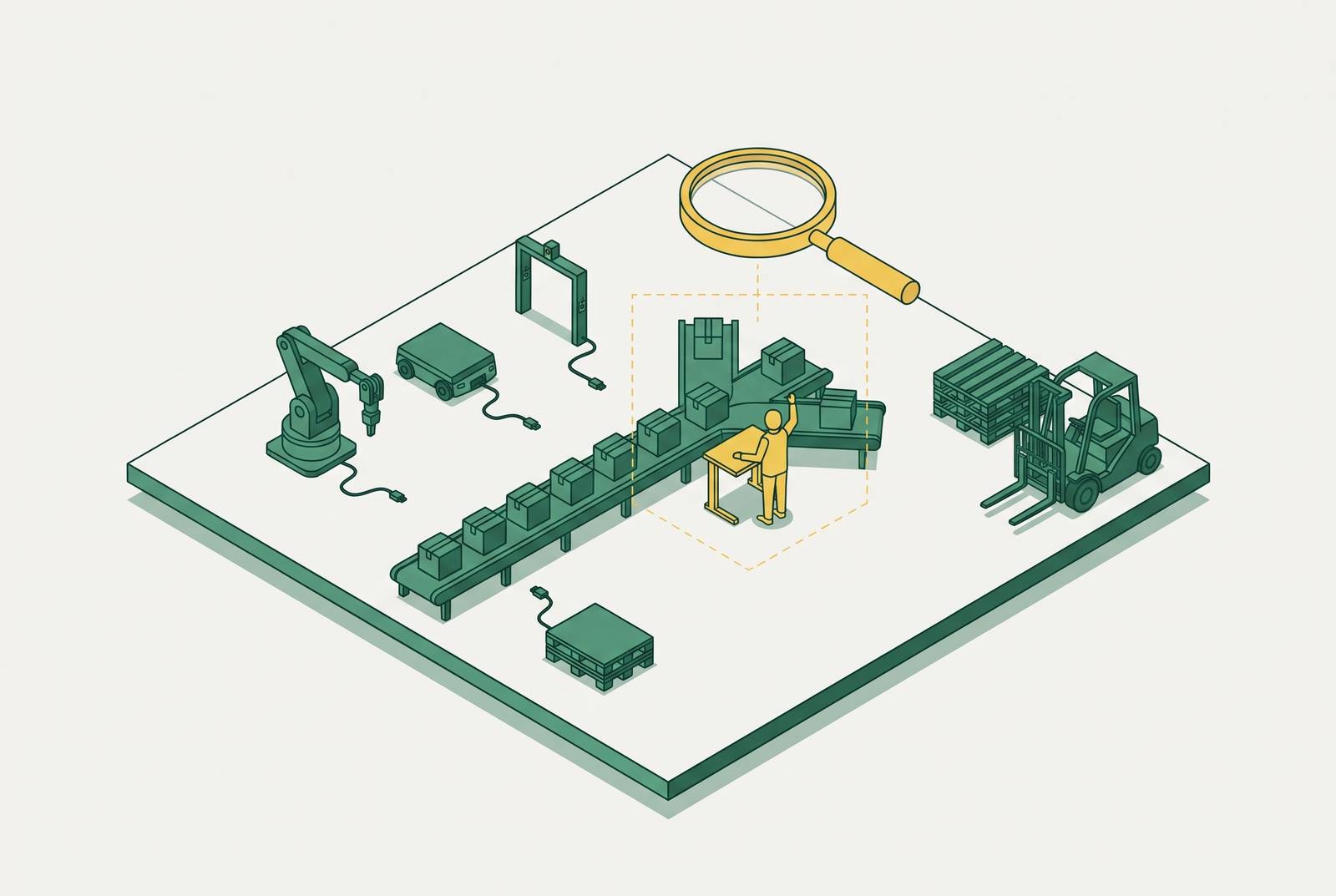
Before implementing AI automation, logistics companies must audit how people actually make decisions, especially where staff override systems, interpret uncertain signals, or bridge missing handoffs. Automating around undocumented judgment can remove a safeguard or encode a flawed assumption. A pre-automation process audit shows which decisions are ready for automation and which need human checkpoints or upstream repair, so the deployment plan sets out how the work will improve.
Why logistics AI deployments keep producing live systems that don't deliver measurable results
TechnBrains’ analysis of 128 documented logistics AI initiatives across 63 organizations found that most reached live production, yet fewer than a third disclosed achieved, quantified outcomes. The gap between deployment and documented operational improvement leaves the results of initiatives without published outcomes unresolved. Nevertheless, it limits what a launch announcement can establish about whether a system improved the operation it entered.
The same analysis found that initiatives showing evidence of scaling disclosed quantified outcomes at roughly twice the rate of those that remained live without scaling. That association separates evidence that a system stayed in use in the operation from evidence that it went live, while leaving the reasons some deployments progressed unresolved. When launch announcements dominate the public record, the industry’s account of progress favors deployment over delivery, leaving unresolved workflow problems difficult to see.
The operation must therefore be able to act on an AI system’s useful output and measure the consequence. If the technology is not the bottleneck, what is?
What the outcome gap actually points to — the workflow handed to the algorithm
Sheer Logistics says the integration gap is the single biggest reason AI deployments stall. Core systems can hold stale inventory positions, use inconsistent order definitions, and surface exceptions hours late. The system makes a recommendation, but no one acts on it. In that situation, greater model capability does not repair the connection between a decision and the work required to enact it.
Data readiness has a behavioral dimension as well. Teams can describe their data as ready while relying on documents nobody trusts, inconsistently completed CRM fields, and retrieval layers drawing from outdated sources. These weaknesses affect what the model receives. Yet even a cleaner data flow may omit the reasoning that experienced staff use to keep the operation functioning.
A coordinator may know when a nominally suitable carrier is the wrong choice or when a delivery exception needs attention before the formal threshold. That reasoning may exist nowhere in the systems being integrated. The workflow supplied to the algorithm is therefore not necessarily the workflow people execute. Its missing structure consists of human judgment calls, including the informal decisions that correct, interpret, and connect the documented process.
What a judgment call actually is in a logistics workflow, and why it stays undocumented
A logistics judgment call is an experience-based decision embedded in normal work but not fully described by the formal process. It is not necessarily an unusual exception. A coordinator makes one when selecting a carrier under borderline conditions, deciding whether to absorb a delay, or interpreting a supplier’s informal warning about lead time. Documentation can seem redundant because the organization trusts the person making the call.
Three forms of judgment require different treatment. Compensatory judgment corrects a known weakness in a system output without feeding that knowledge back into the system. Discretionary judgment chooses within a documented policy range using intuition, relationships, or pattern recognition that the policy does not encode. Bridging judgment connects processes that have no formal handoff, filling a gap that the process design leaves unresolved.
A compensatory override may reveal a defect to repair, while a discretionary choice may represent legitimate flexibility. A bridging decision may show that no one is responsible for what happens between two documented steps. Sheer’s position that AI augments human decisions rather than replacing accountable people depends on those boundaries being visible. An organization cannot specify what the system should augment until it knows what the person contributes.
What happens when you automate around undocumented judgment — the failure mechanism
Automation can mishandle undocumented judgment in two ways. First, it can remove the decision altogether. If a coordinator’s compensatory override was preventing a downstream error, replacing that coordinator’s decision with the formal system output also removes the correction. The process then follows its documented logic while losing the intervention that made that logic workable.
Automation can also encode the judgment without anyone checking it. Training data or rules may preserve a preference for a particular carrier, an inconsistent practice, or a decision suited only to old network conditions. The choice remains, but its rationale becomes obscured. Correcting upstream data errors does not necessarily expose faulty reasoning that shaped the data in the first place.
USPS’s retail wait-time computer vision pilot produced mixed results because success depended on staff availability to respond to alerts and other outside variables. The national rollout of its sensor-enabled location system was halted because of cost. These cases do not establish that undocumented judgment caused either outcome, but the wait-time case shows why generating an alert is not equivalent to resolving the condition it identifies.
Scale compounds an unexamined assumption after that dependency fails. A multi-step agent can make successive decisions that each presume the preceding step was correct, while undocumented reasoning leaves no clear route back to an owner or corrective action. Gartner forecasts that governance failures will lead 40% of enterprises to demote or decommission autonomous AI agents by 2027.
Why the judgment calls most likely to cause failures are also the hardest to surface
Experienced coordinators often make the most consequential compensatory decisions so fluently that they no longer recognize them as decisions. The correction feels obvious to the person making it. A process description can therefore omit precisely the intervention that prevents a cascade, even when the person describing the work is knowledgeable and cooperative.
Bridging judgment creates a different visibility problem. It picks up where formal documentation stops and joins activities that the process map keeps separate. Reviewing each documented activity can leave the connection unexamined. Discretionary judgment is easier to acknowledge in principle, but the policy range alone does not reveal how relationships or changing conditions determine the actual choice.
Asking staff to articulate these decisions can also feel like challenging their competence. That reaction is itself a signal about where the process depends on trusted expertise. It is not simply an obstacle to bypass.
Those findings illustrate the distance that can open between a formal planning record and current execution. They show why auditing the record alone cannot establish workflow readiness.
What should a logistics company audit before implementing AI automation tools?
A pre-automation judgment audit examines granular decisions within the target workflow. The method begins at each data input, handoff, and exception trigger. It identifies who decides, what informs the choice, and what happens when the default answer does not apply. Experienced coordinators and the staff handling these transitions supply the decision logic that the formal record lacks.
The first question concerns documentation and actual practice. Is the decision recorded anywhere, and does that record match what the person does? For carrier selection, a documented rate rule is not a complete answer if coordinators routinely deviate under borderline conditions.
Does the choice vary by person, shift, volume, or carrier relationship? Variation is not automatically a defect. The audit must distinguish context-sensitive reasoning from unexplained inconsistency before treating either as a rule to encode.
Is a billing adjustment correcting an upstream rate discrepancy, or is the person exercising a genuine first-order judgment?
What would depend on this choice if it were made incorrectly at automation speed? Together, the answers show which judgment can be encoded, which needs a human checkpoint, and which upstream failures need to be fixed first. Post-deployment observability can monitor model behavior, but it cannot substitute for identifying the human decisions that preceded it.
Where the audit most reliably finds undocumented judgment in logistics operations
Carrier selection under non-standard conditions is a concentrated source of discretionary judgment. Contracted logic may cover standard lanes while coordinators rely on relationship knowledge and performance history when conditions deviate. The relevant gap is specific. It lies between the conditions the rule describes and the conditions staff recognize as requiring a different choice.
Exception handling exposes decisions made before formal thresholds. A process may specify when escalation becomes mandatory without explaining how a coordinator distinguishes a one-off delay from a developing pattern. Procurement interfaces contain a similar gap. Calls, emails, and supplier information scattered across inboxes can leave staff continuously interpreting whether materials or capacity will arrive when needed, without recording the signals behind that assessment.
Settlement and discrepancy resolution often expose compensatory judgment. Experienced billing staff resolve invoice mismatches, duplicate charges, and rate discrepancies in transportation management system data through pattern recognition that workflow documentation does not describe. The resolution is visible. The reasoning may not be.
Order allocation adds another useful starting point. Sheer describes AI replacing static rules with decisions based on what is happening in the network. Before that replacement, however, people may already be deciding when to enforce the static rules and when to deviate. Mapping those decisions establishes what the replacement logic must preserve and which existing defects it should not inherit.
The objection — auditing is slow, and competitors are already deploying
Senior supply chain leaders are deploying AI onto existing workflows. An audit can therefore seem to hold a company back while its competitors gain experience. That concern is reasonable, but it treats reaching production as the decisive competitive outcome.
The deployment evidence does not support that equivalence. A live system can still accumulate costs, unresolved dependencies, and governance problems before demonstrating useful results. GXO Logistics provides a distinct example of why deployment and return must remain separate claims. After multiple pilots and a multi-year commercial deployment with Agility Robotics, GXO announced further expansion in October 2026, while its CEO had acknowledged that ROI had not yet been achieved. The program was not discontinued, and expansion itself did not establish a return.
A team under competitive pressure should begin with reversible, low-stakes automation in a workflow whose judgment calls have been surfaced. It should measure results rigorously and expand only as reliability is demonstrated. This sequencing narrows the audit to the decisions needed for the first implementation, rather than making the entire organization’s process redesign a prerequisite.
How to scope the first automation target once judgment calls are mapped
The audit’s output should rank decisions by their readiness for automation, their need for human review, and their dependence on upstream repair. The first target should contain consistent, context-stable, explicable judgment. Experienced coordinators make the same choice under the same conditions and can explain why. That reasoning can be encoded, tested against historical outcomes, and reversed if the encoding proves wrong.
Human checkpoints should stay where the choice depends on how carriers behave, how much a supplier can be trusted, or new patterns in exceptions. Compensatory judgment calls for upstream repair before automation. Otherwise, the implementation preserves the workaround instead of removing the defect that made it necessary.
Sheer describes agentic AI as an execution layer that can reroute a shipment, trigger a purchase order, or escalate when parameters are breached. The audit supplies the basis for those escalation boundaries. It determines where the agent can decide and where a person must remain accountable, rather than leaving that division to a vendor’s default configuration.
A bounded workflow then gives the implementation team a specific process, a defined decision boundary, and a measurable outcome to achieve. The audit makes the first deployment concrete enough to deliver in weeks.