AI Agent Role Design in Logistics Dispatch Operations
Specialized agents with bounded roles replace dispatcher bottlenecks in enterprise logistics.
AI agent role design in logistics dispatch starts with one broken process. Effective AI operations transformation for asset-heavy industries assigns bounded responsibilities for constraint evaluation, re-optimization, carrier orchestration, and exception handling. For a logistics operation or a manufacturing plant without a digital roadmap, the starting principle is the same. Audit the process, set the limits on its decisions, and put the first role to work before adding more.
Why single-layer AI dispatch fails at enterprise scale
In conventional dispatch, delivery assignment is a scheduling problem that relies on rules and the dispatcher's judgment. A request arrives, the system considers driver availability, proximity, vehicle suitability, and the SLA, and a dispatcher reviews the assignment. This works at moderate scale with predictable demand. Beyond that, the dispatcher becomes the fallback for decisions the scheduling engine cannot resolve.
The resulting failures are structural. SLA performance becomes inconsistent across regions, driver utilization runs uneven, and exception handling consumes dispatcher capacity faster than headcount can absorb. Customer experience then depends on which dispatcher worked which shift. Adding a single AI layer does not solve that problem if it leaves the same decision bottleneck intact.
Enterprise dispatch must evaluate hours-of-service regulations, vehicle capacity, hub turnaround times, traffic and weather, fuel and emissions targets, regional compliance windows, customer preferences, carrier performance history, and SLA economics per delivery. These constraints affect one another, so they must be checked together. The architectural test is therefore whether the system can evaluate that constraint complexity at depth in real time, rather than present a rule-based scheduling engine through a modern interface.
What agentic dispatch actually means — agents as distinct operational roles, not features
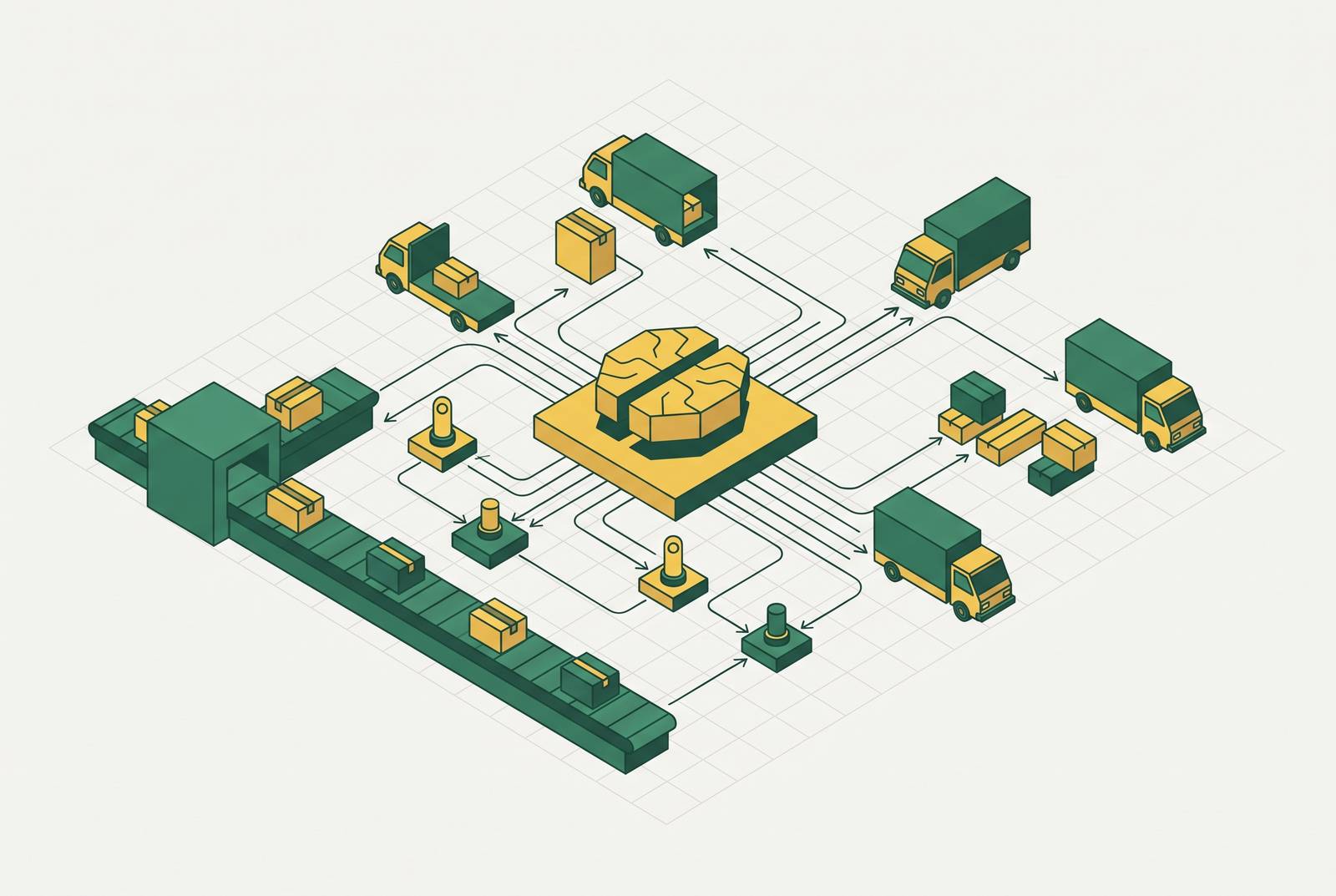
Agentic dispatch distributes that constraint complexity across specialized agents with defined decision domains. Each agent owns a bounded responsibility and collaborates with other agents when a decision crosses its boundary. The workflow changes because responsibility for its decisions changes.
Locus's DiSCO framework gives this architecture a concrete vocabulary through its Dispatch Agent, Capacity Agent, Hub Agent, Customer Agent, Carrier Agent, Settlement Agent, and Orchestrator Agent. Its Mycroft AI Co-Pilot supports human dispatchers and drivers through in-cab and in-field decisioning. The Dispatch Agent collaborates with the Capacity Agent on driver and vehicle availability and with the Hub Agent on facility turnaround and yard capacity. The Customer Agent supplies delivery preferences and availability profiles, while the Orchestrator Agent handles which work takes priority across the network.
These product roles illustrate specialization, but they do not replace the need to define functional ownership. An architecture must still establish who evaluates an assignment, who changes it during execution, who manages carrier decisions, and who classifies exceptions. That distinction makes the system a redesign of dispatch. It also allows agentic AI to enrich existing TMS, WMS, and ELD systems while keeping them in place.
The four functional roles every dispatch agent architecture must cover
The four required functions are constraint evaluation, real-time re-optimization, carrier orchestration, and exception handling. They need distinct scopes even when a product organizes its agents under different names. Each scope must identify both the work the agent owns and the point at which it hands responsibility elsewhere. Without those boundaries, dispatchers remain the universal override for an architecture intended to remove that bottleneck.
Constraint evaluation owns the assessment made at assignment time. Its job is to evaluate hours-of-service, vehicle capacity, hub turnaround, traffic and weather, emissions targets, regulatory windows, customer availability, and SLA economics together. Locus's Dispatch Agent evaluates this constraint surface through machine learning models trained against enterprise dispatch patterns. The bounded output is an assignment-time evaluation for dispatcher review or the orchestrator.
That boundary matters because assignment and execution run on different decision cadences. Constraint evaluation checks whether a proposed assignment fits the conditions at the time. Continuous re-optimization asks whether an assignment already in motion should change as conditions develop. Combining both in one decision loop mixes different inputs and produces stale optimization. Once execution begins, monitoring departures from the plan belongs to the re-optimization role.
Real-time re-optimization owns that continuous layer. It monitors in-flight deliveries, detects drift from the plan, and evaluates whether rerouting improves the outcome within cost and SLA constraints. Unlike a batch process that waits for the next planning cycle or a dispatcher intervention, it can respond while the delivery is underway. Its authority remains bounded by established parameters. A reroute that requires a different carrier, exceeds a cost threshold, or changes a customer commitment must pass to the orchestrator or a human.
Carrier orchestration owns a different decision domain, including carrier selection, load tendering, performance scoring, and rate benchmarking. These network decisions are interdependent, but they do not belong inside per-assignment routing logic. Automated performance scoring and rate benchmarking make selection data-driven. Locus's Carrier Agent occupies this separate role within DiSCO. When a carrier no-show or capacity gap falls outside automated rebooking rules, carrier orchestration hands the case to exception handling.
Exception handling owns classification and the routing of a response. A two-minute reroute belongs with re-optimization, a routine customer notification can be handled autonomously, and a planner decision requires human judgment. The agent detects deviations such as a late scan, weather hold, or customs inspection, assesses who is affected, and triggers the appropriate response. That response may be a reroute suggestion, a customer notification, or an operations alert with context already gathered. The value lies in sorting the event correctly before its consequences spread.
A truck running late is a physical problem, but the calls, ETA updates, appointment reschedules, and document requests that follow are an information problem. Consider the cascade when a driver is held at the previous stop. The ETA for the next stop is missed, three parties call at once, and the dock slot is given away. The truck then waits, and waiting time becomes a detention invoice. Good exception handling keeps the delay itself separate from the extra work of coordination that can be avoided, while recognizing that the agent cannot fix the physical cause.
The dark-data problem that makes role design fail before it starts
Even clear role boundaries fail when the field data they need never reaches the system in a form it can use. In logistics, status updates pass through WhatsApp groups, radio calls, driver messages, and spreadsheets. A chassis pool operator may manage hundreds of units generating dozens of status events per week, including gate-in, gate-out, drop-off, pickup, M&R dispatch, and repair completion. If those events remain in messages rather than maintenance systems or fleet dashboards, the agents cannot act on the actual state of the fleet.
A dispatcher message makes the problem concrete. “Chassis 48923 gate-out 14:32, destination DC, motor back on, driver is Marcus” contains equipment ID, status, timestamp, destination, event, and driver. An agent can extract those fields and immediately produce a structured system record. The operational change is making a field event available to the roles that depend on it.
This is a role-design constraint because each function needs a different part of that operational record. Constraint evaluation cannot assess fleet availability without current chassis status, while re-optimization cannot work meaningfully without live ETA signals. Exception handling cannot prevent a cascade if it receives a manual log hours after the disruption. Capturing WhatsApp messages, radio transcripts, and driver texts as system records makes those roles executable without waiting for a separate system-integration project. Data integrity is therefore the first task of governance, to be addressed before deployment.
How to set the autonomy level for each agent role
Autonomy should match the reversibility and consequence of the decision. Constraint evaluation can hold high autonomy because it computes within established policy. Its outputs serve as advisory inputs to dispatcher review or the orchestrator. That distinction allows the computation to proceed without giving the agent authority over the commercial consequences.
Re-optimization can make routine reroutes and send notices when the changes stay within the set cost and SLA parameters. It must escalate when a change requires another carrier, breaches a cost threshold, or alters a customer commitment. Carrier orchestration can choose carriers on its own within performance and rate parameters, while people stay involved in new carrier onboarding and contract decisions.
Exception classification should run on its own, but the type of exception should determine who has the authority to resolve it. Routine ETA notifications and appointment rebooks can use act-and-notify handling. Damage claims and SLA breaches with commercial consequences require human decisions. The boundary is between sorting the work and making a commitment that the role is not authorized to make.
Advisory outputs can anchor judgment when a reviewer trusts the recommendation because it came from an automated system. Meaningful review requires enough context to reconstruct how the agent reached its output in terms a dispatcher can evaluate. Otherwise, a nominal approval step leaves the underlying transparency gap untouched.
Governance gaps that appear only after agents go live
Production exposes combinations of edge cases, coordination problems, and data conditions that pilots may not surface. The paper The Agentic Company OS: Substrate Inversion for Sustained Enterprise Agent Deployment identifies five recurring failure modes. Governance gaps occur when agents act outside policy, while transparency gaps prevent reviewers from reconstructing their actions. Coordination gaps arise when agents drift out of step, and safety gaps occur when untrusted content contaminates trusted reasoning. Plateaued improvement describes deployments that stop improving despite model upgrades.
These failures become harder to control when the underlying process was never standardized. Terminal Use's operational audit starts with how dispatch actually runs, where constraint handling breaks down, and how much dispatcher time exception handling consumes. It uses that assessment before deciding whether a single-layer redesign or a multi-agent architecture is the appropriate rebuild. The diagnostic matters because automating an undefined workflow only moves its unresolved decisions into production.
Evidence must also be gathered as the work happens, before an audit begins. Cycle times, exception logs, SLA breaches, ownership gaps, and manual overrides expose where the workflow actually fails. Gartner's June 2025 announcement expects more than 40% of agentic AI projects to be canceled by the end of 2027 because of escalating costs, unclear business value, or inadequate risk controls. That forecast does not identify technology failure as the explanation. Governance is what makes role boundaries hold under production conditions.
How to fix one broken dispatch process without buying a whole platform — from audit to live agent
Start by showing exactly how the process runs today and where it hurts. The audit should find constraints that were judged wrong, re-optimization done by hand, exception types that take up dispatchers' time, and carrier choices made out of habit. It must also establish which parts of the process run through WhatsApp, radio, or spreadsheets. Otherwise, the architecture will assume clean inputs that the operation does not produce. A process-audit-first approach, including Terminal Use's, makes this assessment the basis for deciding what to rebuild first.
The first function should be high-volume and low-ambiguity rather than the most sophisticated role in the proposed architecture. Shipment status and ETA handling, appointment rebooking, and exception classification provide starting points. The first agent should be live in weeks. Integration depth matters more to that timeline than model choice, with ERP, TMS, and WMS connections separating a four-week deployment from a twelve-month one. Evaluate the integration library early and favor an architecture that enriches existing systems without requiring migration.
Live accountability should precede expansion. The first role should make real decisions, keep exception logs, and yield SLA data that can be measured before the second role is designed. That sequence exposes handoff requirements through actual operation rather than parallel pilots without shared accountability. In Terminal Use's approach, rebuilding how a department runs begins with this specific process rather than an AI layer imposed on existing scheduling logic. The practical test remains simple. If the process cannot be defined clearly, the agent cannot execute it reliably.