Process Audit Interview Techniques for Operations Directors
Directors often describe what should happen, not what actually does.
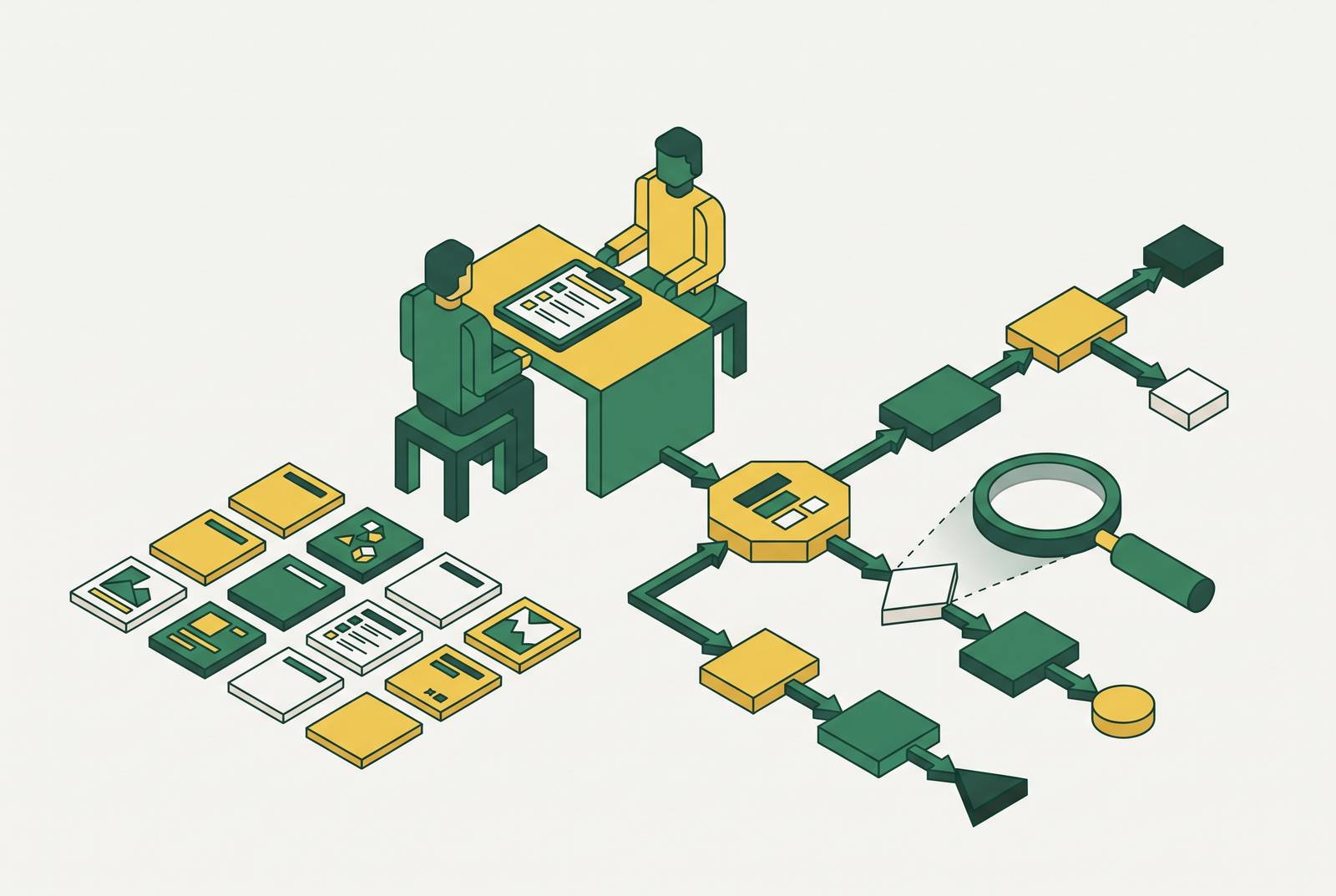
Every process audit runs into the same structural fact: what an organization declares as its process and what it actually executes are almost never identical, and the space between the two is where operational risk gathers. This divergence rarely comes from dishonesty. It accumulates through workarounds that never get written down, shortcuts that solve a Tuesday problem and then quietly become the norm, and tribal knowledge that lives in a supervisor's head rather than in the procedure manual. Documents describe a process as it was designed. Interviews reveal the process as the people running it understand it. Observation and records show how the work actually gets done. These three pictures rarely match, and that mismatch is the reason interviews are always paired with document review, records, and direct observation: testimony alone cannot close a gap it cannot even fully see.
A logistics audit involving a 38-person, 3-depot operator made this concrete. The primary depot ran a structured morning briefing every day. Depot 2 briefed informally, whenever the supervisor happened to remember. Depot 3, newly opened, had no structured briefing process. Three depots, one company name, three different operational realities, and nobody had set out to deceive anyone. That is what process drift looks like at modest scale: not a rogue employee cutting corners, but an organization whose declared procedure quietly stopped describing what three different teams actually did each morning.
Adding an AI layer to a process does not shrink this gap. It tends to hide it more effectively. An AI system can generate outputs that look entirely correct while the workflow underneath it stays broken: the declared transformation is real on paper even when the operational transformation never happened. EY's cross-sector research captures the pattern precisely: platforms go live, recommendations get generated on schedule, and commercial and supply chain teams still fall back on manual workarounds to reconcile forecasts, trade plans, and supply constraints, because they have not actually built trust in what the system tells them. The AI is declared. It is not embedded. That distinction, invisible from a dashboard, is exactly the kind of gap a process audit interview exists to find.
The highest-signal, highest-risk interview subject: operations directors
Operations directors generate a distinctive kind of testimony: accurate about strategy, unreliable about execution, because their knowledge of daily operations is filtered through layers of middle management before it reaches them. They are hired to set direction and judged on results, and that tension shapes how they answer questions under audit conditions. Faced with a question about how a process runs, a director will default to the frame they manage upward with, the SOP, the KPI dashboard, the vendor agreement, rather than the field-level detail they may never have directly observed.
A director can describe the declared process with complete accuracy and still have no idea that the supervisor at a third site has never run a structured briefing in the time since it opened. The higher up the interview subject sits, the wider the gap tends to be between their account and what is happening on the floor, the depot, or the job site, an ordinary consequence of organizational scale rather than evasion. Directors rarely lie; the risk is treating a director's answer as operational ground truth when it is, at best, a statement of intent, and that substitution is the same category error that lets broken processes persist for years without anyone noticing.
The stakes of that error scale with the project. In mission-critical delivery work, energization readiness, procurement sequencing, commissioning schedules, treating a director's declared readiness as operational fact can be severe enough to delay an entire project. What shows up on a schedule as complete may only be approved-in-principle, and timelines quietly fail in the distance between those two states. Power has moved from a downstream utility afterthought to a primary constraint on design, scheduling, and investment decisions: grid access, redundancy architecture, and long-lead electrical infrastructure now rank among the most material risks in delivering mission-critical projects on time. When a director says energization is on track, the question an auditor needs answered is whether redundancy has actually been designed, procured, and scheduled, or whether it has only been declared.
The same logic applies to AI governance, and it gives the auditor a specific, usable test. Ask the director to name the owner of each AI agent deployed in their operation. A director who cannot answer that question should raise the same flag as a director who cannot name who owns a critical procurement decision. Both answers point to the same underlying condition: declared governance has run ahead of actual governance, and nobody is accountable for the gap between them.
Building enough trust to get past the defensive register
None of the techniques that follow work until the interview subject believes the auditor is trying to understand the process rather than build a case against them, and that belief has to be established deliberately at the start of the conversation, not left to incidental small talk. Most people find being audited uncomfortable under the best of circumstances. An auditor who walks in with a clipboard and starts firing questions gets shorter answers, more guarded responses, and testimony with most of the useful detail already filtered out before it reaches the page.
The opening minutes of the interview set the tone for everything that follows. The frame established there either opens the space for honest testimony or closes it. The practical move is simple: introduce yourself, state what process is under review and why, and make explicit that the purpose is to understand how work actually gets done, not to evaluate the person sitting across from you. A line like "My goal today is to understand how this process works and identify areas where it can be improved, so please feel free to share any challenges" does real work here. Stating the auditor's actual purpose out loud changes what the interview subject is willing to say next.
Humility and curiosity function as practical skills in this setting, not personality traits layered on top of the real work. An auditor who shows genuine interest in how the work runs, rather than whether it checks a box on a compliance form, consistently gets more operationally useful testimony back. With operations directors specifically, acknowledging the strategic complexity of their role before moving into execution questions lowers the reflex to get defensive, a reflex that often comes from feeling their competence is on trial rather than the process itself.
Admissions can be accepted at face value, while claims require evidence. But that admission only happens if the director feels safe enough to make it, and the trust-building moves above are designed to produce that safety.
Asking questions that force demonstration over description
Once that trust exists, the single most important shift in technique is moving the conversation from description to demonstration. A described process can always be the declared one, the polished version that lives in the SOP. A demonstrated process reveals what actually happens, because demonstration requires producing evidence rather than narrating intent. The operating rule is straightforward: investigate a claim, accept an admission. When someone describes their process, that description is a claim and it requires evidence. When someone admits a gap or a workaround, that admission is sufficient on its own.
The failure this corrects is common and easy to fall into. Auditors often skip the request for proof of conformity simply because the person answering sounds logical and confident, and nobody wants to come across as distrustful. The fix is a single habitual question, asked after any process description: "Can you show me?" That question shifts the burden of proof from the auditor to the interview subject, and it works across nearly any operational context. If a director says equipment inspections happen monthly, ask to see a recent inspection record. If nonconformities run through a formal tracking system, ask to see a recent example pulled from it. If energization is reported as on track, ask to see the procurement schedule laid next to the project schedule, and compare the actual dates. If an AI agent has been deployed into a process, ask to see who owns it, what KPIs are being tracked against it, and when its outputs were last reviewed by a human being.
Five question starters cover most of what a process audit interview needs: "Walk me through…", "What happens when…", "How do you know if…", "What would you do if…", and "Can you show me…", with the last one serving as the pivot point from description into demonstration. Asking "Do you have a procedure for customer complaints?" invites a one-word answer. Asking "Can you walk me through what happens when a customer complaint comes in?" forces the director to narrate the actual sequence of events, and gaps surface in that narration on their own.
"What happens when" and "what would you do if" are particularly effective for probing exceptions, because declared processes describe normal operations, while the real divergence between declared and executed process appears in exceptions, failures, and edge cases. In construction and logistics, that is precisely where the operational risk lives: what happens when a long-lead electrical component arrives late, when a depot supervisor is out sick, when an AI recommendation conflicts with a field technician's own judgment.
Getting a useful answer to any of these questions depends on active listening, not just the question itself. Let the answer run its full length. Resist the instinct to jump in and fill a pause. Use short prompts, "Tell me more about that," "And what happened next?", "Can you give me an example?", to draw out operational detail the subject would not have volunteered otherwise. Silence is not a failure of the conversation. It gives the other person time to think, and it often prompts them to add the detail that mattered most. Pay attention, too, to what the subject's manner communicates: hesitation before answering a question about a specific step, vagueness that sharpens the moment the topic changes, a shift in confidence between talking strategy and talking execution. Those moments are exactly where the auditor should stay, not move past.
Deciding who else to interview and what those conversations are for
Interviewing only the operations director produces the most confident and least operationally accurate picture available of how a process actually runs. The people closest to the work are the check against every strategic-level declaration, and skipping them is one of the most common mistakes in process auditing: relying only on senior managers, when the people who best understand how a process operates day to day are usually the warehouse staff, site supervisors, technicians, administrators, and team leaders doing the work itself.
The three-depot logistics case demonstrates why this matters structurally rather than anecdotally. The divergence between the primary depot's structured briefing, depot 2's informal one, and depot 3's absent one was completely invisible from the director's seat. It only became visible once the audit reached the people actually running each morning's operations. It reflects a genuine information asymmetry built into organizational distance: a director's account is incomplete by structural necessity, not by any failure of honesty.
The practical sequence follows from that. Interview the director first, to establish the declared process. Interview front-line staff and supervisors next, to map the process as it is actually executed. Then compare the two accounts, because the gaps between them are the audit's actual findings. Front-line interviews deserve the same preparation as the director interview: know the process in advance, know the role, and know precisely which steps need to be walked through. Front-line staff are also often more forthcoming about gaps and workarounds than managers are, provided they believe the auditor is not building a case against them personally. The same trust-building moves from earlier in the process apply here too.
In operations running on AI-augmented workflows, these front-line conversations carry an additional purpose. They establish whether the people receiving AI-generated outputs actually trust them, or whether they quietly override the system and keep doing things their own way. An override rate that nobody tracks is itself a finding: it means the AI integration has been declared but never actually embedded into how decisions get made. The EY pattern, recommendations generated but teams hesitating to act on them, only becomes visible once someone asks the people on the receiving end what they actually do when a recommendation lands in front of them.
Verifying testimony against records before drawing any conclusions
However candid an interview is, and regardless of how many levels of the organization it reaches, it produces a description of the process as the subject understands it, remembers it, or believes it to be. That description has to be tested against objective evidence before it can be treated as a finding. Interviews work alongside document review, records, and observation, and the interview's job is to point the auditor toward what to examine next, not to serve as the conclusion itself.
The sequencing logic is simple to state and easy to apply. The interview tells the auditor where to look. The records tell the auditor what actually happened. The gap between those two things is the finding. If a director reports that the procurement schedule is tracking to plan, pull the actual purchase orders, line up the committed delivery dates against the project's milestone dates, and check specifically for long-lead items that have not yet been ordered. If a supervisor says equipment inspections happen every month, pull the inspection log and count the entries across the last quarter: the log will not lie about cadence even if memory does. If AI agents are reported to be in production, ask for the output logs, the defined KPIs attached to them, and evidence of the most recent review by a named business owner. Production deployment without any of that observable governance is a declaration, not an operating reality.
This is the discipline that separates a process audit from a management conversation that happens to use audit language. An auditor does not resolve a contradiction between what a director says and what a supervisor says by asking a third person for their opinion. The contradiction gets resolved by going to the records and finding out what actually happened.