Shadow Workflow Mapping in Construction Operations
Unmapped workarounds in construction hide profit leaks until they surface in financial reviews.
A distribution company rolled out a new order-approval workflow to stop margin erosion. The official process reported full compliance. Actual compliance ran closer to 60%, and nobody found out until a quarterly margin review turned up profit leakage nobody could otherwise explain, not through any audit of the process itself.
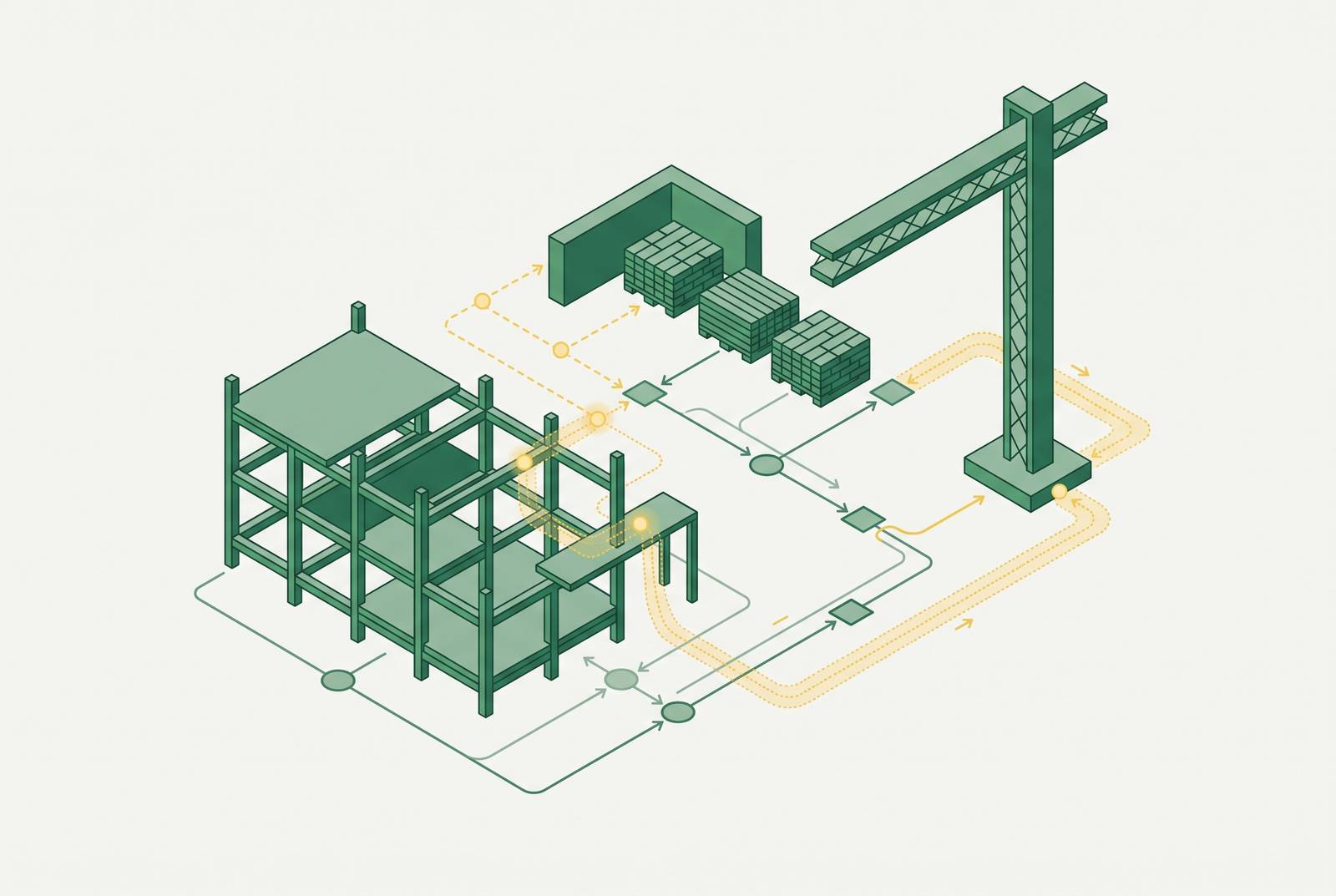
That sequence, official plan, quiet workaround, financial damage discovered months later, is the pattern this piece is built around, and it maps onto construction with almost no translation required. Fragmented MEP fabrication operations produce the same three-way split every time: design teams model in one environment, fabrication shops run off spreadsheets, and field crews work from paper updates that lag whatever changed upstream. Three workflows that are supposed to connect, connecting on paper only.
None of this happens because crews are cutting corners or ignoring procedure. It happens because the declared process, the one written into the project manual or built into the software, was never designed to match the speed and ambiguity of actual field conditions. A superintendent who improvises around a stale drawing isn't defying the system; the system gave nobody a faster way to get the same job done, so someone found one. Treating that as a disciplinary problem misses what is actually going on: the workaround is evidence of a design gap, not a character flaw, and closing the gap means fixing the process rather than the person.
Where shadow workflows form in construction
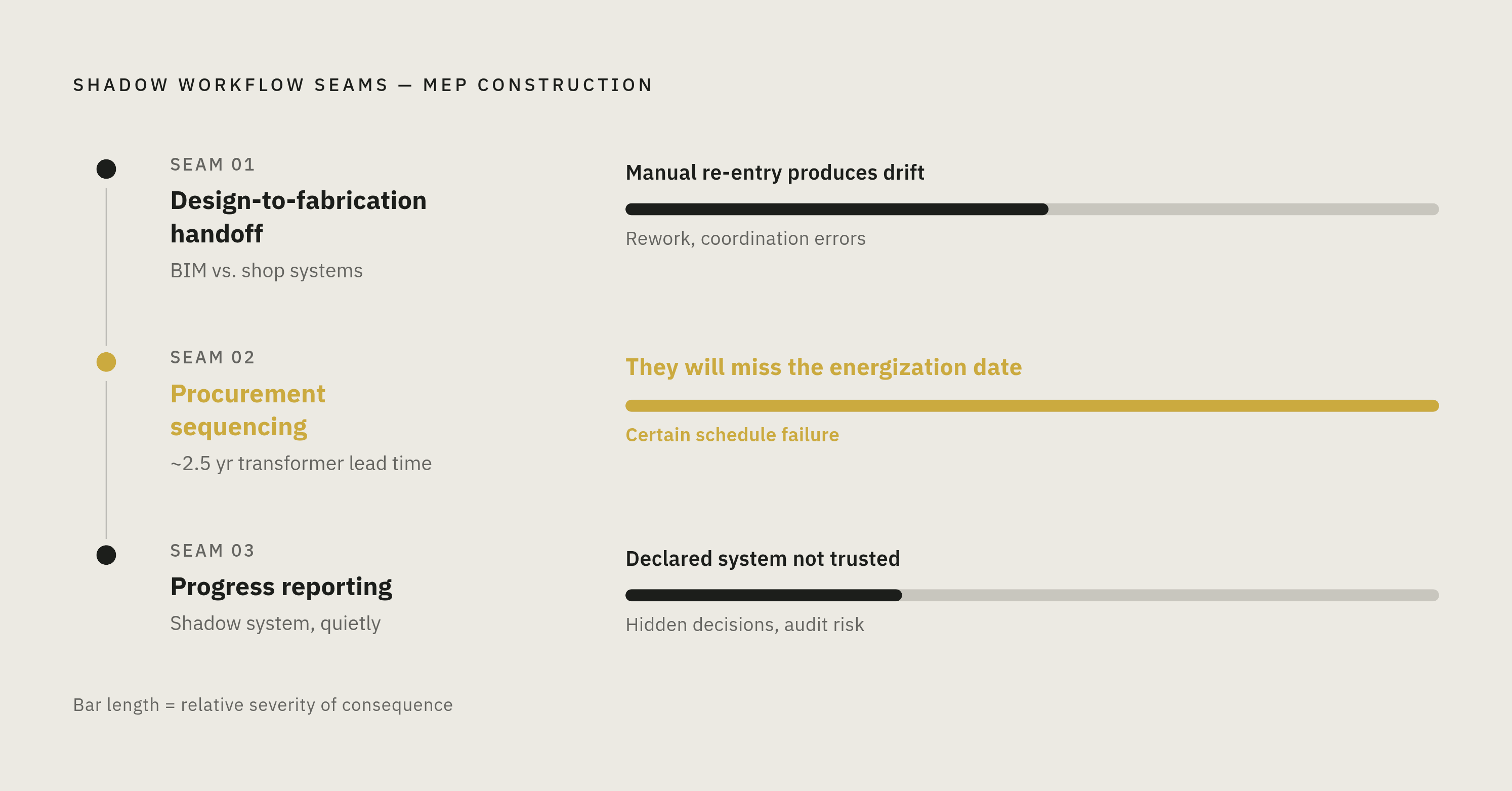
Shadow workflows don't scatter randomly across a project. They collect at specific seams, the handoffs, the sequencing decisions, the reporting steps, where the declared process asks for something the operation can't actually deliver on time.
The design-to-fabrication handoff is the first and most reliable one. When BIM models live in one system and fabrication shop inputs live in another, whatever crosses that boundary tends to be stale, incomplete, or retyped by hand, and every manual re-entry is another chance for the shadow version to drift from what the model actually says. The documented failure modes are specific: miscommunication between BIM, fabrication, and site installation teams, poor visibility into shop throughput or materials, and delays traced back to outdated data or change documentation that never made it downstream. An incorrect hanger detail doesn't just cost the crew an afternoon. It produces a field improvisation that gets built, works, and is never written down anywhere official.
Procurement sequencing is the second seam, and it's arguably the sharpest one right now. The declared process assumes design finishes before procurement starts. Power transformers currently run roughly two and a half years of lead time, and generator step-up transformers run longer still, so a sequence that waits for design completion before ordering equipment simply cannot hit an energization date. Leading EPC firms have already responded by building schedules around delivery windows instead of design milestones, committing to long-lead equipment before design closes out. What started as a workaround has become, in some firms, the actual declared plan. Projects still running the traditional sequence, design first, procurement after, aren't at risk of missing their finish date. They will miss it.
Progress reporting is the third seam, and it's the quietest one. Estimating progress without verification persists even on projects with formal reporting systems already in place. The shadow workflow runs on top of the declared one, not instead of it.
The sharpest illustration of all this sits in energization readiness. On industrial, data center, cold storage, and advanced manufacturing projects, the utility energization date is the real critical path, not the one drawn into the CPM schedule. Owners have hit substantial completion, walked the punch list, and then waited months for a transformer set and a utility meter, a delay that isn't an inconvenience so much as a financing event, with interest carrying and lease-up deadlines slipping in the background. Procurement milestones for long-lead equipment have to be built into the CPM directly. Skipping that step keeps the hidden critical path hidden until it's too late to do anything about it.
What the gap between declared and actual process costs
Most construction firms underestimate what their invisible inefficiencies actually cost, and they underestimate by a wide margin, because the declared process was never built to show where the work really goes. Surfacing that cost takes honest interviews with operations staff and a look back through historical project data, rather than a review of the process document itself.
The visible half of this is schedule delay. A 2024 analysis of 180 construction project schedules found that roughly 75% of projects run late, with median overruns eating up a meaningful share of total project duration.
The energization case makes the point more sharply: reaching substantial completion and then sitting idle for months waiting on a utility connection is a financing event, one that never appears on any schedule deviation line, where interest keeps accruing and lease-up or operations deadlines pass unlogged because, technically, construction finished on time.
At the extreme end, the Philippines flood control investigations found ghost projects, inflated contracts, and substandard work, with less than half of allocated funds traceable to any verifiable output. That's a shadow workflow running at institutional scale, not a construction schedule problem, but it shows the same mechanism scales far beyond a single project's procurement office.
What ties all three together is that design teams modeling in one environment, shops running from spreadsheets, and field crews working from paper updates officially connect but practically diverge. The gap between what was declared and what actually happened gets discovered at a margin review, at project closeout, or after a financing event has already occurred, never during execution, when there was still room to correct course. There's a fair objection here: some shadow workflows genuinely make things better. Crews find quicker paths, informal coordination smooths over friction that the official process never anticipated. That's true, and it doesn't undercut the case for mapping. It strengthens it. A mapped shadow workflow that turns out to work well is a candidate for becoming the new declared process. An unmapped one, good or bad, is just an unknown sitting inside the operation, waiting for a margin review to expose it.
What shadow workflow mapping involves as a field discipline
Mapping a shadow workflow starts with people, not paperwork. The process document was never going to show where it breaks; the operations staff running it every day already know, and getting that knowledge out takes honest interviews about where things slow down, where the team routes around the system, and what informal channel exists next to the official one. The question that gets an answer is not "does your team follow the process," but "walk through how this step gets done on an ordinary day, and then show what happens on the day it doesn't work.
Process mining, the practice of combing through IT system event logs to reconstruct what actually happened rather than what was supposed to happen, gives this a data layer. In construction the equivalent move is comparing GPS-verified labor logs against the crew assignments that were scheduled, or comparing a physical progress scan against the baseline CPM. Platforms that pair GPS-verified time tracking with real-time job costing, Workyard among them, produce exactly this field-evidence layer, the record of what happened that the declared CPM was never built to capture.
Physical installation offers the clearest example of what closing this gap looks like in practice. Dusty Robotics' FieldPrint platform lays out physical markings on site from the digital model, and as of April 2026 contractor crews can run it themselves without a vendor technician standing over the equipment. That's field evidence captured at the exact point of installation, which is what makes it possible to compare the layout plan as declared against the layout as physically marked on the slab.
None of this points toward a flowchart of the ideal process. The output of a mapping effort is a record of where the actual process diverges from the declared one, with each divergence annotated against why it exists and what it costs to leave unaddressed. McKinsey's research on construction productivity finds that gains come from workflow redesign paired with digital integration, not from dropping a new tool onto an old process. A tool applied to the declared process leaves the shadow process running underneath it untouched. Mapping is what shows which parts of the workflow actually need to be rebuilt.
Framed as a discipline, the exercise works best when it's run as a process audit: the team walks through how a process runs today, and where it causes pain, before anyone decides what to rebuild.
Shadow workflow mapping as a prerequisite for AI deployment in construction operations
When an AI agent is placed on top of a process nobody has mapped, it doesn't fix that process. It runs the broken version faster, at machine speed, stripped of whatever informal human corrections were quietly keeping it functional.
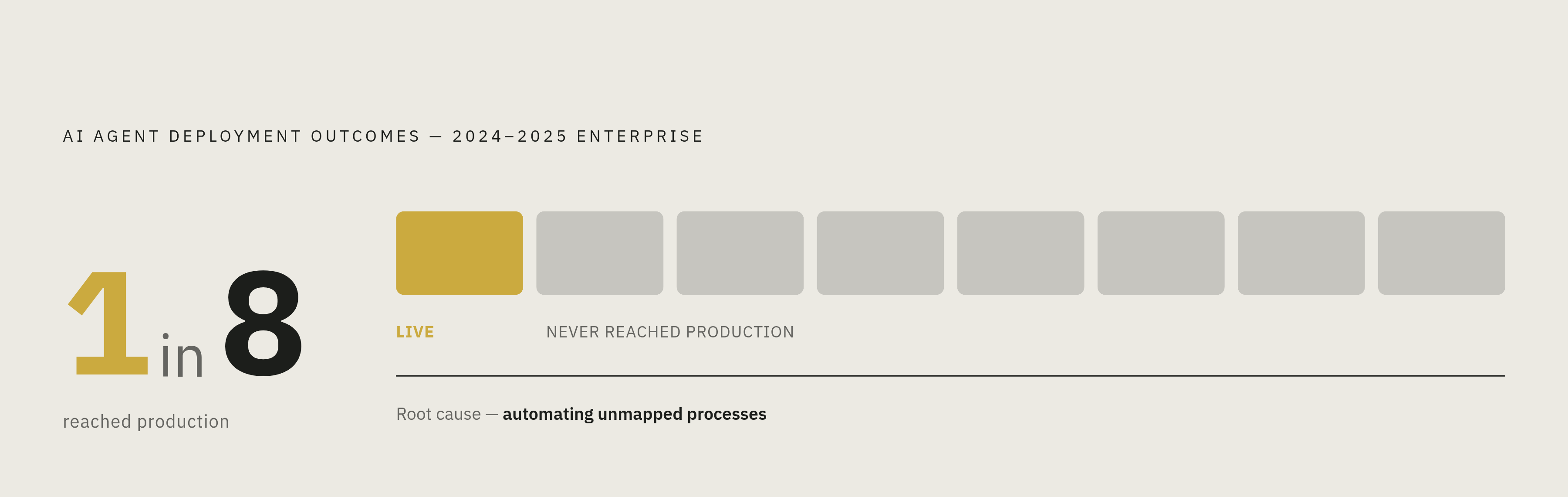
That failure mode is already visible at scale. Analysis of enterprise AI agent deployments across 2024 and 2025 found that fewer than one in eight agent initiatives ever reaches production operation. The reason usually gets filed as architectural, but the deeper cause is operational: organizations are trying to automate a process they never actually mapped. The ones that succeed do the opposite. They identify the workflow first, chart every decision point in it, and ask what that process would look like if it had been designed for an agent from the start, a question that almost always produces a workflow different from the one currently running.
Agent deployment fails or backfires under specific, well-documented conditions: unstandardized processes, broken workflows sitting underneath the automation, unclear regulatory guidance, and no clear owner accountable for the outcome. Shadow workflow mapping surfaces every one of those conditions directly, because finding them is the entire point of the exercise.
There's a newer and sharper risk sitting on top of this. Security researchers have started naming a distinct category, shadow operations, the uncontrolled spread of autonomous agents executing logic, calling APIs, and changing system states with no formal security oversight watching any of it. This is shadow workflow running at machine speed: agents wired in at the repository level through GitHub actions, API integrations, or orchestration layers that sit entirely outside what security or operations teams can see. Security leaders report genuine uncertainty about where their own agents are deployed, what those agents are permitted to do, and what systems they can reach. Most organizations are responding to this by building governance after the fact, triggered by a security incident, a compliance finding, or a board asking pointed questions, rather than before deployment scales. Governance bolted onto a system already in production costs more and disrupts more than governance designed in before scale happens.
Set against that, a Fortune 100 consumer goods case shows what the alternative looks like. A triage layer routes internal employee requests across specialist agents handling HR, finance, and operations, each running its workflow sequentially under one shared layer of governance, identity, and audit. That's governed orchestration replacing shadow routing, and it only worked because someone had mapped what the shadow routing actually was before designing its replacement.
Mapping shadow workflows before they become failure modes
Skip the platform strategy. The highest-leverage place to start is one process, specific and already known to hurt.
The right candidate runs often, crosses multiple handoffs, and is a process the team already knows, informally, where it breaks. If people can describe the workaround the moment you ask, the shadow workflow is already running and already visible to whoever does the work. In construction operations, three candidates recur across projects: the change-order-to-fabrication handoff, procurement milestone tracking for long-lead equipment, and the progress reporting process that feeds schedule updates. None of these are theoretical; each one is a documented point of divergence. On industrial and data center work specifically, energization readiness deserves its own look, since failing to integrate long-lead procurement milestones into the CPM is a known and recurring cause of hidden critical paths.
The first mapping effort should produce a single gap document covering the process as declared, the process as actually observed, the specific points where the two split apart, and the workarounds currently keeping the work moving, each one annotated with why it exists. That document tells an operations team something concrete: whether the gap is a process design problem that needs the official procedure rewritten, a tooling problem where the system doesn't support how the work actually gets done, or a coordination problem where an ambiguous handoff gets resolved ad hoc every time it comes up.
That's also what separates real shadow workflow mapping from a compliance audit. A compliance audit asks whether people followed the process. Shadow workflow mapping asks what people actually did and why, and the answer to that second question is what makes real improvement possible.