Documenting Workarounds as Evidence of Systemic Process Failure
Workarounds are operating systems confessing what designed processes conceal.
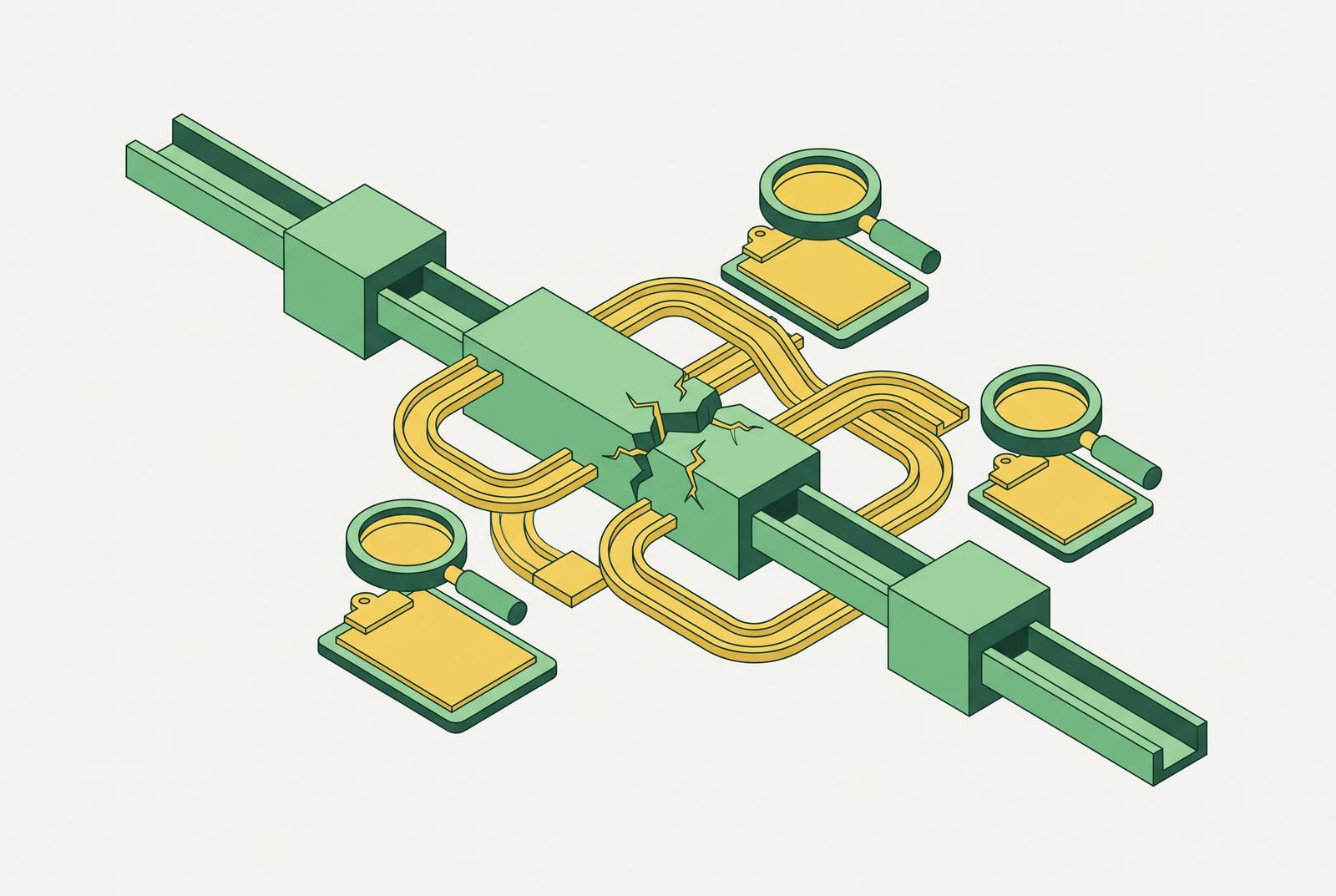
A workaround is the field telling an organization, repeatedly and in detail, that the process on paper does not match the process that actually moves work forward. Treating a workaround as a discipline problem misses what it is: a verdict the operation has already reached, whether or not leadership has read it yet.
Why workarounds are field verdicts, not individual improvisation
Consider a procurement team that keeps an old vendor spreadsheet running in parallel to the official system, updating it by hand every week even though the company paid for a platform meant to replace it. On a dashboard, this looks like a training gap or a change-management failure. In practice, the spreadsheet is the real system, and the official platform is the one nobody trusts enough to use for decisions that matter. The team did not abandon the new tool out of stubbornness. They abandoned it because the data in it was wrong often enough that relying on it created risk they were not willing to carry.
This is the pattern behind most durable workarounds: they persist because the designed process fails the people who have to run it, not because the people running it lack discipline. A workaround that disappears the moment someone complains was never load-bearing. The ones worth studying survive audits, survive new software, and survive management turnover, because they are solving a problem the designed process never solved.
Any real workflow has three layers. There is the designed process, which is what the org chart and the procedure manual say should happen. There is the actual process, which includes every workaround, every exception, every informal routing that gets work done when the designed process cannot. And there is the data trail, which records whether the system captured what actually happened. Most audits only check the first layer against the third, confirming that declared steps match recorded steps, and leave the middle layer largely unexamined. That middle layer is where the organization's real operational logic lives, and interviews surface it more often than dashboards do.
"We handle exceptions by emailing the CFO directly." "The procurement team kept their old vendor spreadsheet because they don't trust the system data." "Approvals happen in our team meeting, not in the system." None of these statements would appear in a process map. All of them are the process.
The compliance/governance split that makes undocumented workarounds dangerous
Workarounds are dangerous specifically because of what they do to two kinds of evidence that usually get treated as the same thing. Compliance evidence shows that a process was followed: the ticket was closed, the form was submitted, the sign-off was recorded. Governance evidence is different. It lets someone reconstruct, after the fact, whether the decision-making process behind that sign-off was actually adequate to the risk involved. A workaround can leave compliance evidence completely intact while destroying governance evidence.
Research on governed auditable decisioning describes this condition as structural accountability collapse: the point where a system's velocity, scale, and opacity exceed what the governance infrastructure was built to handle, so governance evidence degrades while compliance artifacts keep piling up untouched. The forms still get filed. The decisions behind them stop being visible.
The result is an audit that finds every box checked and concludes the process is healthy, while the actual decision happened in a hallway conversation, a side spreadsheet, or a text thread that left nothing behind. This is closer to the normal operating condition of most process-intensive enterprises than a rare failure mode confined to badly run organizations, and it stays invisible to any audit that only checks whether the declared steps got completed.
The practical consequence for an operations leader is uncomfortable: a clean compliance record inside a workaround-heavy environment should not be reassuring. A record that clean, in an operation complex enough to generate exceptions constantly, is more likely evidence that the audit itself is measuring the wrong layer.
Where workarounds concentrate in construction, procurement, and energization
In construction and infrastructure operations, workarounds cluster at two points: the handoff between procurement and the field, and the reporting that is supposed to confirm a project is ready for energization. These are the points where what gets declared on schedule diverges most sharply from what has actually been verified on site.
The procurement-to-field disconnect follows a predictable shape. Material data lives in systems run by procurement, tracked by logistics, and summarized in monthly reports that were never built to speak the language of field sequencing. Those reports do not flag risk in terms of outage windows or contractor standby costs, because that is not what they were designed to track. Field plans get built on the assumption that materials will be ready, not on verified confirmation that they are, and when a single switch or transformer does not show up on time, multiple follow-up truck rolls, remobilization costs, and a widening gap between what the field records and what the project management system shows can result. The parallel vendor spreadsheet that procurement keeps running is the field's honest adaptation to a system it has learned not to trust.
Energization readiness reporting makes this same split visible at regulatory scale. Southern California Edison's biannual energization report names material procurement delays, including delays in obtaining switches, transformers, and cables, alongside permitting delays from local Authorities-Having-Jurisdiction as sources of schedule disruption. Each jurisdiction carries its own requirements, and a single project can need permits from several agencies at once. SCE's own report acknowledges that its current systems do not fully track these delays across all eight steps of the energization process, so the declared readiness and the verified field status can diverge without the organization's own tracking tools catching it.
Scheduling itself generates the same pressure. The Critical Path Method, still the default scheduling framework for large construction programs, struggles with schedule disturbances because of its static structure and its inflexible adjustment mechanisms. Practitioners build informal workarounds around that rigidity constantly, and those workarounds are exactly where a declared schedule and the real schedule start pulling apart well before a project visibly fails. Digital infrastructure projects, particularly data centers and the energy systems that support them, concentrated this pressure through 2025, with large volumes of specialized equipment, tightly coordinated deliveries, and sequencing precise enough that static scheduling tools simply cannot represent it.
The industry's own hiring has started to reflect this. OpenAI's posted specification for an Electrical Commissioning Lead explicitly requires discipline in maintaining logs, test evidence, issue records, and decision history. That requirement is an acknowledgment, stated directly in a job posting, that delivering mission-critical infrastructure depends on field evidence captured as it happens, not on a retrospective declaration that everything went according to plan.
Why most process audits are designed to miss workarounds
A standard process audit is built to confirm that declared steps were completed. That is the wrong question to ask once the actual process has already diverged from the designed one, because confirming completion of the wrong steps proves nothing about whether the real work is sound.
Compliance-oriented audits check artifacts: the submitted form, the closed ticket, the recorded sign-off. They confirm that evidence exists. They confirm only that evidence exists, measuring the presence of paperwork rather than examining the decisions and routing that actually produced it.
Operations leaders who resist documenting workarounds usually raise a fair objection: surfacing how teams actually work creates organizational exposure, and it can trigger a compliance crackdown that eliminates the informal knowledge holding the operation together, slowing everything down in the name of fixing it.
The answer is that the exposure already exists. Undocumented workarounds are generating liability right now, compounding quietly, and they will eventually surface as a public failure: a missed energization date, a procurement stoppage, an approval chain that collapses under its own informality. Guidance for Firm Operational Resilience requires firms to identify and document the people, processes, technology, facilities, and information needed to deliver each important business service, treating that mapping as a core obligation rather than an optional exercise, though the guidance stops short of naming the comparison between actual and designed processes as a required step. Audits that go looking for deviations, compliance gaps, and inefficiencies in how work really happens are what let an organization redesign its processes based on reality. Without them, every redesign is built on a theory of how the work gets done, not on the work itself.
What a workaround-aware audit examines
An audit built to surface workarounds starts at the actual process layer, before it checks anything else against a procedure manual. It begins by asking a team to show, step by step, how a process runs today and where it causes pain, rather than mapping the declared workflow first and checking for conformance against it.
That starting point is what surfaces the parallel spreadsheets, the email threads that substitute for the system of record, the verbal approval chains that happen in a meeting instead of a platform, and the informal exception handlers who have quietly become the real process owners. The audit also surfaces something less visible in the step-by-step walkthrough: where a single person or a single step has absorbed complexity that the designed process assumes is distributed evenly across a team.
The output is a map of exactly where the designed process fails the people running it, with each workaround sorted into one of two categories: a process gap that needs fixing, or an informal practice that works well enough to formalize. Methods for identifying the root causes of operational incidents make a similar distinction, separating surface-level deviations from the structural failures that generate them. A workaround-aware audit is built to reach that structural layer.
A workaround that has been documented and understood becomes a design input the organization can act on. A workaround nobody has found yet is a liability sitting quietly in the operation, waiting to produce a failure nobody can explain after the fact.
How AI agents amplify the cost of undocumented workarounds
Deploying an AI agent on top of a process whose actual workflow has never been audited does not fix the gap between the designed and the real process. It automates the designed process, the one on paper, and carries the workaround forward at machine speed across the entire enterprise.
The mechanism is straightforward. A person who routes around a broken step in a spreadsheet-driven process keeps that workaround contained to their own desk. An agent reasoning over incomplete or incorrect data does something different: it infers the most plausible action available to it and acts, at volume, without flagging that anything unusual happened. Research on failure management in multi-agent systems shows that existing diagnostic approaches tend to overlook historical failure patterns, which limits how accurately a failure gets traced back to its cause. Agents that fail across a meaningful share of real interactions waste compute, trigger remediation work, and create liability wherever they touch systems outside the organization's own walls, because most of those failures trace back to process failures the agent inherited.
AI deployment has already produced its own version of undocumented workarounds spreading unchecked. Teams building unofficial agent pipelines to get around slow governance processes are doing what the procurement team did with its spreadsheet: finding a faster path around a system they do not trust, with the workaround running in code. That makes shadow AI development the AI-native form of the same phenomenon that workaround documentation exists to catch.
Microsoft's supply chain organization, which deployed well beyond its own stated goal of operational agents by the end of 2026, stands as a useful benchmark for the gap between most enterprise deployments and what disciplined deployment looks like. Operational discipline in mapping how a process actually runs before anyone tries to automate it, not model quality, is what separates them.
What workaround documentation changes about the rebuild decision
With a documented map of its workarounds in hand, an organization can ground the rebuild decision in evidence the field has already supplied, rather than guessing at which process might be broken. The workarounds themselves show which processes are failing, where the real risk sits, and which process deserves attention first.
That map also draws a line between two kinds of workaround that require opposite responses. Some workarounds capture real operational logic that the designed process missed entirely, and those deserve formalization. Others exist only because an upstream failure is forcing a team to compensate downstream, and those need the upstream failure fixed, not the workaround preserved. Formalizing a practice that works is a different intervention from repairing the broken step generating the workaround in the first place, and conflating the two leads to fixing the symptom while leaving the cause untouched.
Automating a process before auditing its workarounds locks the gap between the designed and the actual process into the new system. Rebuilding after that point gets harder, not easier, because the automation has created new dependencies on the very structure that was already broken.
The right place to start is never a platform strategy or a sweeping transformation roadmap. It is one specific, painful process, chosen because the evidence points to it, not because it fits a strategic narrative. A workaround map is the most reliable way to find that process, because the field has already cast its vote through behavior, long before anyone thought to ask.
Sources
- Governed Auditable Decisioning Under Uncertainty: Synthesis and Agentic Extension
- Guidance for Firm Operational Resilience VERSION 3
- Efficient Failure Management for Multi-Agent Systems with Reasoning Trace Representation
- Method and system for identifying systemic failures and root causes of incidents
- Leveraging Workarounds for a Problem-Focused Improvement of Business Processes
- A Procedural Framework for Assessing the Desirability of Process Deviations
- The State of AI in the Enterprise - 2026 AI report
- R2401018-SCE Biannual Energization Report per ...