Rework Rate as a Process Health Metric in Field Operations
Rework rate reveals upstream process failures that standard metrics miss.
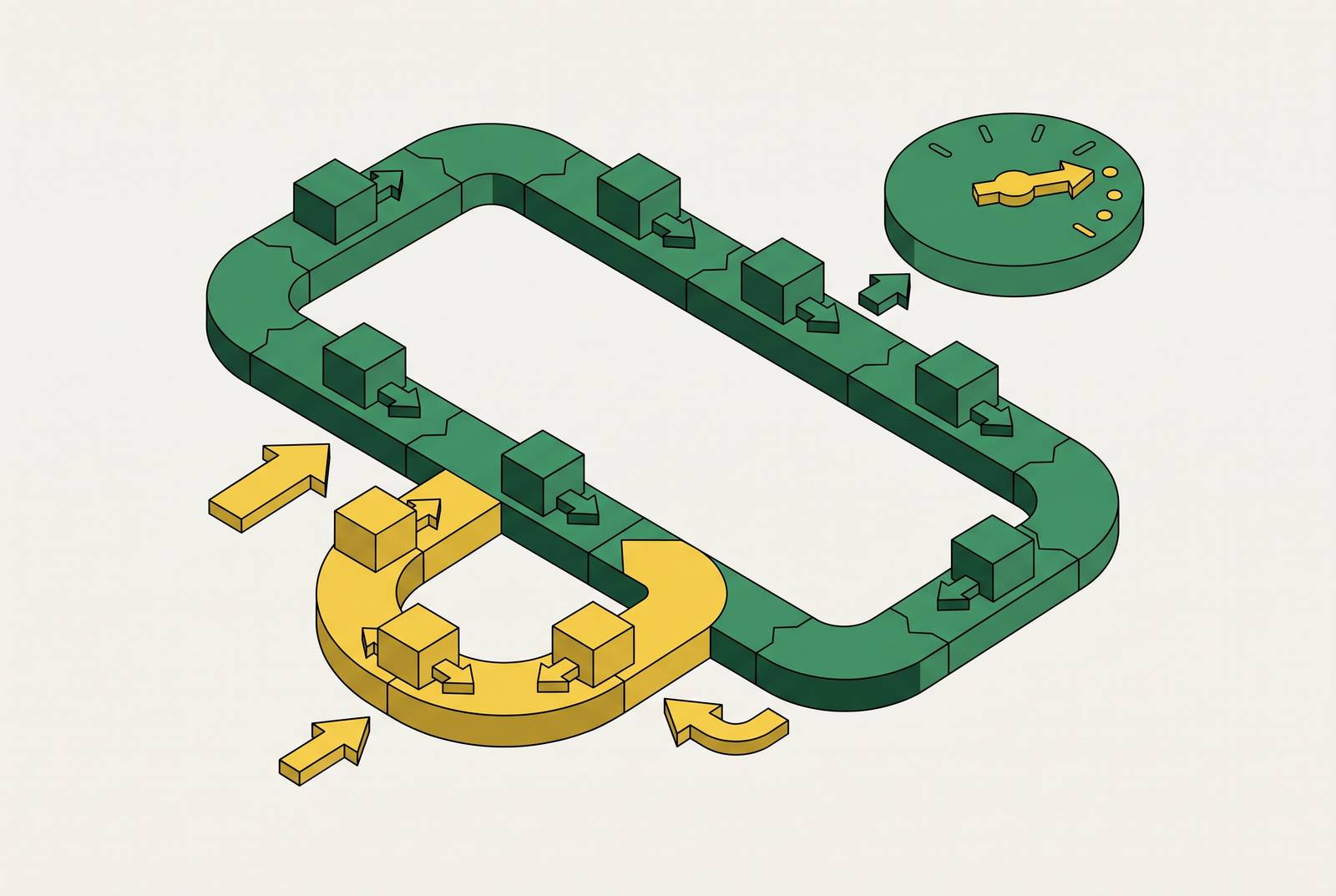
Rework rate measures something fundamentally different from the metrics it sits beside on a typical dashboard. Defect frequency and inspection pass rate record workmanship at the moment of production: a weld fails, a wall gets flagged, a system doesn't pass its first test. Rework rate records the cumulative cost of a failure that was already in motion long before a crew ever touched the material. Standard KPI frameworks define rework rate using a formula like rework cost divided by total project cost, and define first-time quality rate separately, as work passing first inspection divided by total inspections. First-time quality rate shows where the failure is concentrated, while rework cost shows how large that failure turned out to be; the gap between the two instruments is where the diagnostic value lives.
The conventional response to high rework numbers treats the problem as a workmanship issue, and that framing sends corrective attention in the wrong direction. It leads operations leaders toward retraining crews, tightening supervision at the work face, or adding inspection steps right where the defect surfaced. None of that touches the actual mechanism, because the conditions that produced the rework were usually set well before anyone picked up a tool. Rework rate deserves a different category because its root causes sit upstream of the crew, in the information and coordination that shaped what the crew was asked to build. What follows traces that upstream chain in detail, but the foundational claim has to be installed here first: rework is not primarily a measure of how well people worked. It's a measure of how well the process around them was built.
Where rework originates: information flows and handoffs
The largest share of construction rework traces back to information failure, not execution failure. PlanRadar research identifies design omissions, inaccurate drawings, and late design changes as among the single largest contributors to rework cost, and all three originate before a crew ever mobilizes on site. A drawing that omits a conflict between a duct run and a structural member doesn't fail because someone installed it badly. It fails because the information reaching the field was already incomplete, and the installation that follows that flawed instruction is often executed exactly as specified. The rework that results is a documentation and coordination failure wearing the appearance of a field error.
Mid-project change compounds this in ways that are consistently underestimated by the people managing the schedule. PlanRadar research found that two in three professionals surveyed say changes drive budget overruns on many or most of their projects, and that changes alone add significant unplanned cost to a typical mid-sized commercial or multi-unit residential job. A late design change introduced after a design freeze doesn't just alter one drawing; it reaches into every downstream trade whose work depended on the original specification. It forces new submittals, triggers rework on anything already built to the old specification, and requires re-testing of systems that depended on the original design. A single decision made at the design desk, often weeks or months before anyone at the site sees its consequences, cascades across multiple trades and multiplies in cost as it moves downstream. The chain runs from an information gap, to a coordination breakdown, to rework at the work face. It does not run from a crew's skill level to a defect. Reading the causal order correctly is what separates an operation that fixes the right problem from one that keeps retraining people for a failure they didn't create.
Why rework is systematically underreported
A reasonable objection to building a metric around rework is that the underlying data is unreliable. Field teams routinely believe their rework is minor, log only a fraction of what actually occurs, and move on once a correction is made without recording it as a cost event. If the raw numbers are this unreliable, is rework rate even defensible as a management metric? The objection has real force, and it deserves to sit for a moment before being answered: the under-reporting is pervasive enough to call into question whether anyone tracking rework cost is seeing anything close to the true figure.
Treating the under-reporting itself as a signal resolves the objection. PlanRadar's 2026 research cites findings from an academic study quantifying the costs of field rework in construction, which shows that field teams' sense that rework is negligible diverges substantially from measured reality once both pre-completion and post-completion corrections are captured. Contractors under-report actual field rework costs by a substantial margin, with real costs running materially higher than what gets logged on individual projects. That gap between perception and measured reality is itself a process health indicator: when rework is invisible to the people doing the work, the information systems aren't surfacing problems until they've already compounded.
PlanRadar's 2025 research sharpens this further by identifying who is most exposed. Firms with no consistent QA/QC standard are the most likely to be operating blind: 43 percent of firms with no set QA/QC standard report having no idea what rework is actually costing them. That number describes a real operational blind spot, not a footnote about weak bookkeeping. It describes an operational condition in which the single metric capable of aggregating upstream failure into one comparable figure simply doesn't exist for nearly half the firms that lack standardized tracking. Rework rate earns its place in a KPI set precisely because no other standard construction metric performs this aggregation. Change order rate signals whether scope was defined properly up front, but says nothing about whether execution matched intent. Inspection pass rate signals workmanship quality, but says nothing about whether the information handed to the crew was sound. Rework rate, tracked with real cost-code discipline, captures the downstream consequence of both failures at once. The measurement problem is solvable: it requires cost-code discipline to make the rework visible in the first place. The systemic signal that rework rate provides once that discipline exists is not available anywhere else in a standard KPI set.
How rework rate patterns point to upstream failure modes
Rework rate becomes genuinely useful once it's broken apart by trade and by phase, because the concentration pattern identifies the failure mode, not just its cost. A single project-level number tells an operations leader how much was lost. A number disaggregated by trade and phase tells that same leader which upstream process broke down and roughly when it broke down.
Consider what it means when rework concentrates heavily in one trade at one phase boundary. If MEP rework spikes immediately after structural close-in, the natural read is that MEP crews underperformed. That read is almost always wrong. The more accurate interpretation is that the sequencing or design coordination between the structural and MEP disciplines was insufficient before either trade started work, and that insufficiency becomes visible and expensive once it appears as rework in MEP. The failure occurred at the handoff, not at the installation.
Procurement-driven rework follows a related but distinct pattern: it rarely gets coded as rework at all, which makes it structurally invisible in most tracking systems. When long-lead equipment submittals aren't approved on schedule, field sequences get disrupted, crews install temporary workarounds, and corrections accumulate quietly over weeks without ever appearing on a rework log. Late design changes introduced after a design freeze force new submittals, drive rework, and require re-testing. When Integrated Systems Testing fails, the consequence isn't a quick patch: the integrated scripts have to be re-run across multiple systems and rooms, and every failure resets the clock on the entire testing sequence. Buyers who receive shipment updates but lack visibility into how those delays ripple through field sequencing cannot judge where the risk is actually spreading. Site leaders respond only after a delay has already begun disrupting work. That is the operational cost of misreading rework as a crew problem: the actual failure point, a procurement handoff with no visibility into downstream sequencing impact, goes untouched while attention is spent elsewhere.
What the indirect cost structure of rework reveals about where operational loss accumulates
The direct cost of correcting defective work is only a fraction of what rework actually costs an operation. The larger loss comes from what rework does to schedule, supervision load, and coordination once an upstream failure reaches the field late enough to disrupt sequencing already in motion. A single late design change doesn't just cost the price of redoing one assembly. It costs the supervisory time spent re-coordinating trades whose sequence it disrupted, and the schedule float it consumes that was meant to absorb some other, unrelated risk.
Schedule damage is where this loss becomes effectively permanent in time-sensitive delivery environments. The CMAA and Navigant Construction Forum have documented that rework produces roughly 9.82 percent schedule growth on average projects, a figure that translates into substantial delay when applied to a multi-year job. In data center construction, where delivery timelines are tied directly to revenue, a delay of that magnitude is rarely recoverable through overtime or re-sequencing, particularly once procurement slots for long-lead equipment have already been missed. Rework is expensive, a fact self-evident to anyone who has managed a budget through a troubled project. The cost structure itself reveals where the real loss accumulates: in the schedule compression, the supervisory overhead, and the coordination strain that ripple outward from the line item for redone work. That is why catching the upstream signal early carries more value than correcting the downstream defect efficiently. By the time the direct cost of rework is visible, the larger indirect cost has usually already been locked in.
Why standard schedule and planning tools miss what rework rate exposes
CPM schedules and project plans are built to capture intent and sequence. They tell an operation what is supposed to happen and in what order. They do not capture the information quality behind that sequence, the integrity of the handoffs between trades, or whether the procurement readiness allows the planned sequence to actually be executed as drawn. A well-decomposed rework rate captures exactly that. It sees problems that a CPM schedule structurally cannot.
Part of the issue is how most schedules get built in the first place: forward from notice to proceed, rather than backward from the critical constraint that actually determines success, whether that constraint is a utility connection date, a commissioning window, or an energization milestone. A forward-built schedule can look perfectly healthy right up until the procurement or coordination risk that was never modeled finally detonates. Research on utility construction delay is consistent on this point: the majority of delay causes technically originate during the construction phase, but most of those causes were seeded much earlier, during design and procurement, where they could have been caught and corrected at a fraction of the cost. That is precisely the origin point that a rework rate disaggregated by phase is built to expose.
The procurement disconnect described earlier is the clearest example of a hidden rework generator that schedules routinely conceal. Buyers who share shipment updates but have no visibility into how those timeline shifts affect field sequencing cannot assess where the resulting risk will spread. That is not a scheduling failure in the conventional sense, where a date simply slips and gets replanned; it is a process design failure, a handoff gap between procurement and field operations that neither a schedule variance index nor a cost performance index is built to see. Rework rate, read correctly, registers it first.
What early rework signal detection requires in practice
For rework rate to function as an early warning signal rather than a report delivered after the damage is done, three operational conditions have to hold at once. The first is cost-code discipline strict enough that rework gets coded as rework when it happens, rather than absorbed quietly into general field labor costs where it disappears from view. The second is phase-level and trade-level disaggregation, so that a rising number can be traced to a specific handoff or a specific point in the sequence rather than read only as an aggregate figure with no diagnostic content. The third is timely data capture from the field communications where the earliest signs of a coordination breakdown actually appear, well before they turn into a logged cost event.
Most operations fail to establish even one of these three conditions consistently, and very few establish all three. The 43 percent of firms without a consistent QA/QC standard, who by their own account have no idea what rework is costing them, are the clearest illustration of what happens in the absence of this discipline. Without it, rework rate collapses back into exactly the kind of lagging, after-the-fact cost summary that this piece has argued it does not have to be. With it, rework rate does what no other standard metric in a construction KPI set can do: it aggregates the consequences of information failure, coordination breakdown, and procurement disconnect into a single figure, legible enough to trace back to its source, and early enough to act on before the next phase absorbs the same mistake.