What a Pre-AI Process Audit Engagement Actually Looks Like in Construction and Logistics Operations
Audits reveal which construction and logistics processes are ready for AI before deployment begins.
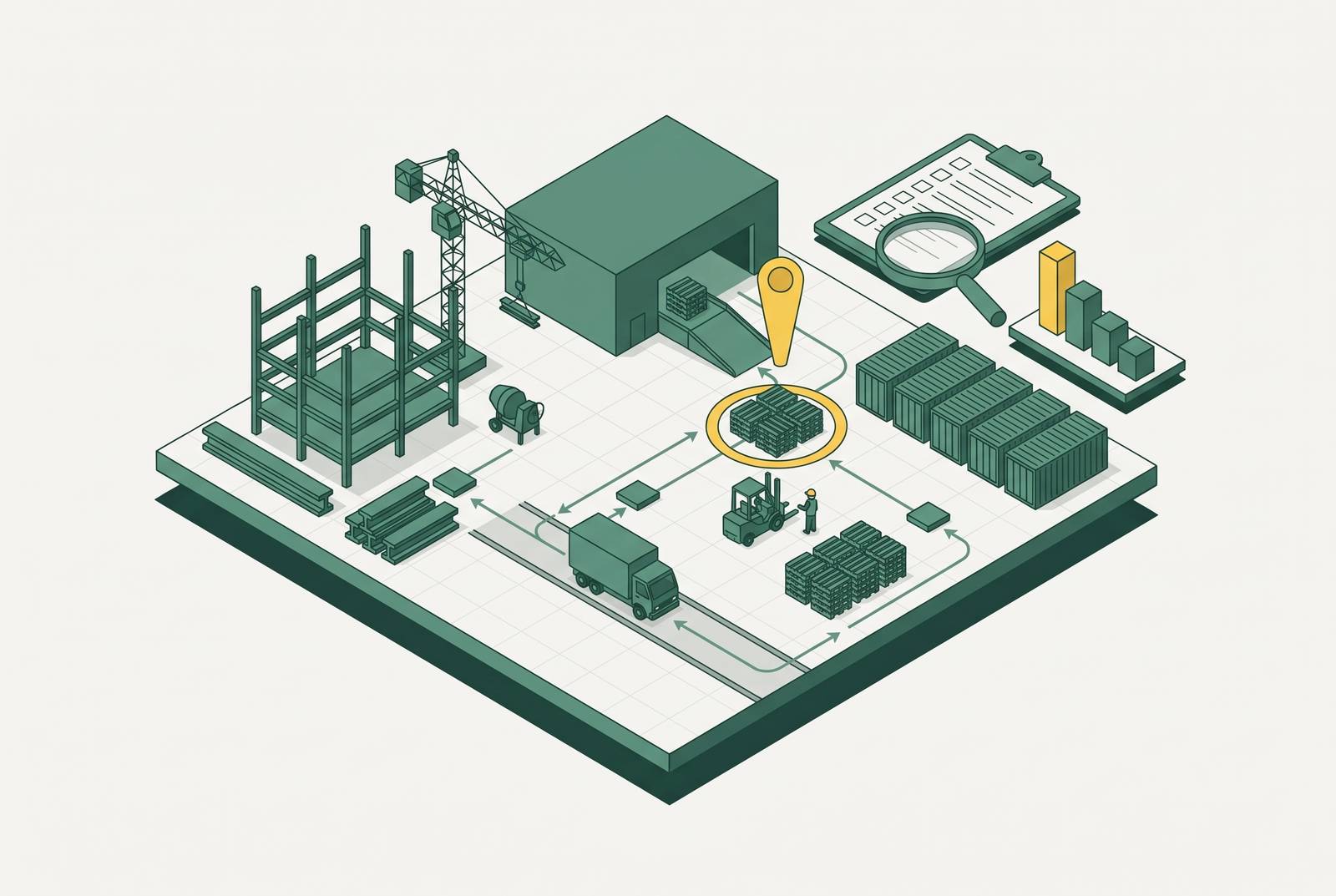
A pre-AI process audit in construction and logistics looks at work in the field to find how it moves, where data goes wrong, and which failures call for process redesign before automation. The audit moves through a process walkthrough, data tracing, structural diagnosis, and an inventory of who owns what. Its purpose is to identify one process that can be rebuilt first, with trustworthy inputs, clear accountability, and measurable results in weeks.
Why a pre-AI audit in construction and logistics is not a discovery workshop
Pressure to adopt AI quickly sits uneasily with the risk of deploying agents onto processes that have never been understood. This phase-by-phase account describes what an audit engagement actually involves. The distinction begins with the question the engagement answers.
A discovery workshop, vendor demo, or platform evaluation often asks what technology the organization should buy. An audit asks how work actually moves today, where it stalls, and whether the process can produce a reliable outcome. Those are different investigations with different outputs. If the organization chooses a tool before answering those questions about the work, it cannot tell which workflows are ready for automation and which are broken and need rebuilding.
What makes construction and logistics uniquely hard to audit
Construction and logistics depend on sequential handoffs between forecasting, allocation, procurement, and execution. Each handoff can separate a decision from the conditions it needs to remain workable. The documented sequence is only part of the process. In construction, trade availability, weather, and rework can sit outside the recorded schedule, while inconsistent cost codes make completed jobs an unreliable basis for forecasting. The gap is structural.
GPS, scan events, sensor readings, and transaction records can make an operation look ready for automation even when its workflows remain siloed, batch-driven, and sequential. More records do not establish a reliable process. An agent applied to one stage cannot, by itself, repair a failure in the handoff to the next stage.
Data center energization readiness illustrates how far a declared plan can diverge from delivery conditions. Wood Mackenzie’s Q2 2025 figures put large power transformer lead times at an average of 128 weeks and generator step-up units at 144 weeks. Projects declaring 2026 delivery targets without reconciling procurement with schedule logic could therefore be structurally undeliverable from the outset. An audit must follow the dependencies that the plan leaves out.
Phase one: the process walkthrough — seeing the work as it actually runs
The engagement begins with someone showing the facilitator, step by step, how a process runs today. The facilitator follows the work. The documented SOP is a version of the process to check against what people do, what they decide, and where they wait. This happens before a questionnaire or system demonstration can define the investigation around what the software already records.
In construction, the walkthrough follows RFI routing, submittal aging, and the procurement cycle as they operate in practice. In logistics, it traces a shipment or warehouse pick from its trigger to completion, including manual steps between system touches. The questions stay close to the work. The facilitator asks where a step waits, who decides when it moves, what happens when the system and field disagree, and who gets called when it breaks.
A large commercial GC illustrates why those questions precede system analysis. Its sophisticated scheduling process kept leaving out trade availability, weather, and rework because those constraints were in people’s heads and were missing from the systems an investigator might check first. The sophistication of the schedule did not make it complete. The relevant finding was the separation between planning and the knowledge needed to make the plan workable.
Phase one therefore produces a record of specific breakdowns, capturing the moments when work stalls, decisions escalate, or records diverge from reality. Those moments become the evidence for the map. Building it from the SOP instead would risk documenting the intended workflow while leaving its operational gaps untouched.
Phase two: tracing where data breaks down before it reaches a system
The second phase follows the data back to its creation. An error can start in a field ticket, cost code, or scan event before it reaches any reporting system. Storage is not the starting point for this investigation. The practical test is whether an agent can act on the resulting record without making the operation less reliable.
Brightwater Foods illustrates how aggregate accuracy can conceal an operationally important weakness. Its plant audit pattern showed cycle count accuracy that was high by value but much lower by item for packaging. Adjustment activity was also concentrated under a single supervisor. A system-level report would not have exposed those distinctions, yet they directly affect whether an inventory agent’s outputs can be trusted.
In construction, a cost-code consistency audit across completed jobs provides an executable test of historical data. If the same scope is coded differently across more than a handful of jobs, the WBS dictionary must be fixed before a model is trained on that history. Otherwise, the model learns from incompatible records. Wood Group’s project digital twin offers a related example of examining information before execution, having identified design discrepancies that were then rectified to reduce execution risk.
For logistics, the equivalent investigation examines what triggers a scan, who validates it, and what happens when it is wrong. The resulting data-readiness map separates streams that can feed an agent from those requiring remediation. It also flags inconsistent streams whose source process needs rebuilding because cleaning the records alone will not fix every defect.
Phase three: mapping the structural failures that tools cannot fix
A structural failure exists when a process produces the wrong outcome even when its steps run correctly. That is a harder diagnosis than identifying errors. The audit asks whether accurate inputs and on-time execution would produce a reliable result under the existing process architecture.
Energization readiness makes the distinction concrete. If transformer and switchgear lead times are not embedded in schedule logic, a scheduling process can correctly execute its own rules and still declare an impossible completion date. A better scheduling interface does not resolve that contradiction. The architecture must connect the procurement constraint to the delivery commitment before an agent can act usefully on either.
Retail replenishment exposes the same defect in logistics. Forecasting improvements could not compound because replenishment still operated through siloed, batch-driven, sequential logic. The forecast was only one part of the system. Improving it without rebuilding the workflow produced no durable gain because the downstream process still limited what could be done with the improvement.
Construction delivery can depend on permitting, policy or regulatory uncertainty, and grid or network readiness that the project team does not control. The audit must map those dependencies even when the project schedule leaves them out. The phase concludes by distinguishing processes that need redesign before AI from those whose architecture already supports deployment. It does not assume that every sequential process is broken or that every delay calls for automation.
Phase four: the governance and ownership inventory
A process can have data it can use and sound architecture but still have no one who answers for an agent’s decisions. The fourth phase checks for that lack of ownership before an agent goes live. Gartner predicts that a significant share of agentic AI projects will be cancelled by the end of 2027 because of escalating costs, unclear business value, or inadequate risk controls.
In construction, the inventory examines who owns an AI-flagged schedule risk and what happens when an agent’s recommendation conflicts with a superintendent’s field judgment. It also examines whether a procurement decision can be traced to the inputs that drove it. The escalation rule cannot remain implicit until a dispute occurs. Without an agreed owner and reviewable evidence, a consequential recommendation may leave no one able to explain or reverse the decision.
In logistics, the same inquiry covers whether routing decisions can be overridden without losing the audit trail and whether inventory adjustments require a second check. Brightwater’s concentration of the majority of quarterly inventory adjustments under one supervisor is relevant here for a different reason than data accuracy. It raises a question about the approval structure. An agent does not remove the need to establish who can authorize changes and who reviews them.
The governance map names the human who answers for each candidate process and lists which decisions an agent may make and which need human sign-off. It also defines the escalation path when the agent is wrong and how its outputs must be logged and reviewed. These are operating rules.
The handoff: how the audit produces a starting point, not a roadmap
The audit ends by naming one process to rebuild first. Selection depends on the intersection of operational pain, data reliability, and a structural problem that can be addressed without redesigning the entire operation. Problem size alone does not make a process the best candidate. The first process must be painful enough for improvement to be measurable, narrow enough for an agent to be live in weeks, and data-clean enough for trustworthy outputs from day one.
A one-process pilot runs in parallel with the existing workflow. That arrangement preserves the baseline while making failure recoverable.
The handoff document names the process, its data sources, its human-in-the-loop rules, and the escalation path for an output no one can act on. It also records baseline cycle time, error rate, and cost per transaction. Those measurements make the engagement accountable for improvement. Without them, a claimed gain lacks a denominator, and vendor case-study percentages remain hypotheses until reproduced in the client’s environment.
A long implementation timeline after the audit is itself a warning. It suggests that the first process was poorly selected or that the investigation did not produce enough clarity to act. The distinction is not simply between a short document and a long one. A roadmap defers value capture into a sequence of future decisions, while a defined starting point makes value capture possible in weeks.
What should operations leaders expect from an engagement, and what should concern them?
Operations leaders evaluating an engagement should expect a process walkthrough before any technology discussion. A first meeting built around a demo or platform presentation is not an audit. The order reveals what is directing the investigation.
The findings should also include uncomfortable limits. Untrustworthy data, broken process architecture, and missing decision ownership cannot all be resolved by deploying software. If every finding happens to be solvable by the firm conducting the audit, independence is in question. The final deliverable should name a first process and a live timeline measured in weeks, rather than substitute a maturity model or multi-year strategy for an operational commitment.
The strongest objection is that investigation takes time when adoption pressure is accelerating. That concern deserves a direct answer. A pilot without a clear starting point produces noise, while its cost includes delayed improvement and the organizational skepticism that follows failure. The audit earns its place by reducing that uncertainty.
The appropriate partner is therefore closer to an operational transformation partner than a software vendor. Relevant experience includes process audits for engineering, procurement, and construction firms, field-grounded investigation, and direct knowledge of construction and logistics failure modes. A commitment to going live in weeks must rest on willingness to recommend rebuilding a process. If the organization gets that starting point right, the first AI-first process becomes operational in weeks, but otherwise the organization is still debating platform strategy a year from now.