Human-in-the-Loop Design for Mission-Critical AI Workflows
Risk-tiered oversight prevents AI approval from becoming either rubber-stamping or bottleneck.
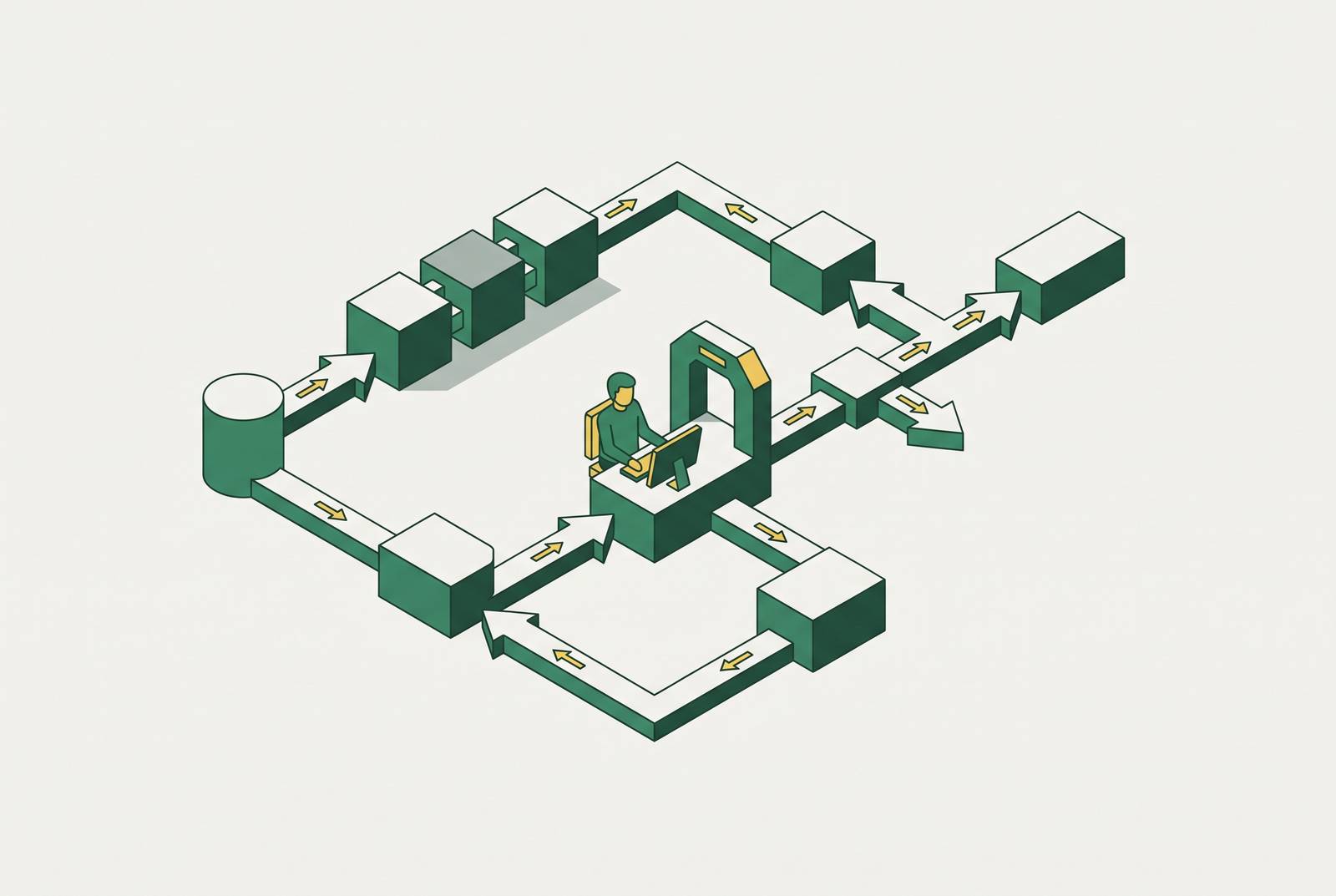
Human-in-the-loop design for mission-critical AI workflows should begin with one painful operations process. In manufacturing, construction, or logistics, the starting point is to audit the actual workflow, classify its decisions by risk, and instrument human review around their consequences. Effective oversight is a risk-tiered architecture, and evidence from that scoped deployment should determine where autonomy expands.
Why uniform HITL approval is the wrong default for mission-critical operations
Enterprises add human-in-the-loop controls to reduce risk, yet the same controls can introduce a less visible risk. When every AI decision requires approval, routine outputs compete with consequential decisions for the same reviewer attention. The safeguard becomes a source of operational fragility. Reviewers must either clear the queue faster than they can assess it or hold up the workflow while they investigate.
A January 2026 Texas Tech paper modeled human override capacity as scarce and congestible, with throughput degrading as queue volume rises. Thousands of low-stakes outputs take up the time reviewers need to check decisions with serious consequences. Adding headcount may absorb volume, but it does not repair indiscriminate routing. Reviewer discipline cannot compensate for an architecture that gives every output the same claim on attention.
EU AI Act Article 14 requires human oversight for high-risk systems. COSO’s February 2026 guidance also recommends human oversight in AI deployments. Neither requirement makes every operational decision equally risky. A uniform gate therefore mistakes the presence of approval for the quality of control. The resulting failure takes two forms, namely HITL theater, where approval becomes a rubber stamp, and a HITL bottleneck, where meaningful review prevents the operation from moving.
What risk-tiered HITL actually means as an architecture
Risk-tiered HITL matches the type and timing of human intervention to the consequences of an incorrect AI decision. At Tier 1, routine, low-consequence decisions execute autonomously, with outputs logged for periodic audit. At Tier 3, decisions with high stakes, those that are hard to undo, or those that touch on policy stay as recommendations until a human approves carrying them out. The architecture distinguishes decision classes rather than granting or withholding trust for an entire workflow.
Edward C. Cheng and Jeshua Cheng’s 2026 decoupled HITL framework treats human oversight as an independent system component. Their framework defines four dimensions for that component. Intervention conditions set when a human steps in, and role resolution finds the right reviewer based on what they know and what compliance requires. Interaction semantics specify what the reviewer can do. The communication channel sets how the handoff works, so review is designed as an exchange instead of adding an approval button to application logic.
This separation allows intervention thresholds to change without reconfiguring the application itself. Governance can calibrate autonomy for a decision class as evidence accumulates, while keeping review behavior consistent across agents. That requires clarity about who drives the process. In human-led systems, humans still make the main decisions, and AI helps them. In HITL systems, AI drives the process and humans intervene selectively, so mixing these models without a coherent allocation of control creates an architectural contradiction.
How HITL theater develops and why it is hard to see from inside the operation
HITL theater develops gradually as review volume exceeds review capacity. From outside the operation, the controls still seem to work because decisions keep getting approved. An AI system can generate decisions in milliseconds across dozens of data sources, while a reviewer sees an output without enough context to reconstruct its basis. Approval records alone do not reveal whether meaningful validation occurred.
Synchronous review compounds the imbalance because the AI waits for a human response before acting. Each request interrupts the reviewer, who must switch context and determine what deserves investigation. Attention degrades throughout the queue, even when it is short. Invoice review, customer support escalation, and claims adjudication exhibit the same structural pattern. The problem does not require negligence, only a review design that asks more of human attention than the workflow permits.
Zekun Wu and colleagues’ 2026 within-participant study of 20 participants compared fragmented execution information with a structured post-task workflow. The study found that validation worked mainly when users cross-checked more than one source of evidence. Cheng and Cheng identify a related structural weakness in approval logic embedded within applications, which produces duplicated logic, inconsistent behavior, and limited scalability. Together, these findings explain why the degradation is difficult to diagnose from approval activity alone.
What reviewers actually need to intervene well, not just intervene
Wu and colleagues developed Trace2Flow, a research probe that translates agent execution traces into editable, executable, graph-based post-task workflows. Their study found that this representation improved understanding and error detection compared with prompt-only review. Reviewers could cross-check evidence across steps. The representation exposed how the task was completed. That is a stronger basis for intervention than the final output alone.
The practical requirement is to design for comprehension before approval. A reviewer needs the source documents behind extracted data, the intermediate outputs needed to assess execution, and an explanation in human language that supports evaluation of the recommendation. The interface must also specify which actions the reviewer can take and how the validated result returns to the pipeline. These are part of the control itself. A checkpoint without adequate evidence can produce rubber-stamping even when review volume is manageable.
Where the risk class permits action before review, asynchronous design separates the review task from the executing workflow. The AI logs the action and routes review separately, allowing the reviewer to examine a complete, contextualized artifact. This does not replace pre-execution approval for decisions that require it. Edith Cowan University’s security operations center framework maps five autonomy levels to HITL roles and task-specific trust thresholds. Its approach to alert fatigue makes routine automation a means of preserving well-supported human attention for genuine decision points.
How risk classification works in process-intensive operations where the stakes vary by step
Risk belongs to each decision node. In construction procurement, logistics dispatch, and manufacturing, the consequences can differ sharply from one step to the next. Reversibility is the primary distinction. A route adjustment in logistics dispatch is recoverable, while a committed procurement decision on a long-lead item in a data center build is not. The same AI capability therefore needs different rules for when humans step in, depending on where its output takes effect.
Downstream dependency adds another dimension because an error can propagate beyond the immediate decision. In construction energization readiness, transformer procurement sequencing affects civil work, structural installation, and commissioning timing across the facility. A daily log entry does not have the same dependency pattern. The SOC framework applies comparable reasoning to task complexity and criticality, allowing more autonomy for monitoring and routine triage than for incident response.
Policy sensitivity is independent of operational consequence or model confidence. A decision that triggers regulatory reporting, a contract clause, or liability exposure requires human approval because accountability cannot be delegated by design. Cheng and Cheng allow intervention conditions to be based on confidence thresholds, decision classes, policy flags, or downstream dependency counts. Classification must also be audited as the workflow changes. A decision may move from Tier 2 to Tier 1 as its track record accumulates, or return to Tier 3 when a new regulatory requirement changes the approval obligation.
Where HITL architecture breaks in production and what the failure patterns look like
Production failures often start with governance that treats autonomy as something that is either on or off. A pilot establishes that an agent can perform a task, and the organization treats that result as permission for autonomous operation at greater consequence or scale. A production incident then exposes a governance gap that existed before the incorrect action. The failure is not only the agent’s decision but the absence of a mechanism for adjusting its permitted scope.
The reverse failure is persistent over-restriction. Well-validated actions remain subject to approval long after evidence supports autonomy, increasing reviewer load and slowing delivery. Teams may turn to shadow development to work around the approved system. That weakens the governance the restriction was intended to preserve. Both extremes arise when review rules stay the same even as evidence from the operation changes.
Behavioral monitoring is necessary to distinguish reliable performance from gradual degradation. In multi-agent workflows, it is also needed to identify which component is responsible when execution fails. The SOC framework treats trust thresholds as adjustable, responding to demonstrated reliability and changing conditions. Adjustment requires more than a record of final outputs. Immutable records of AI recommendations, human decisions, and departures from recommendations provide the evidence for calibration, while their interpretation depends on an accurate account of the underlying process.
How to start AI in one broken operations process with a process audit
The documented workflow is not necessarily the workflow that runs the operation. Construction, logistics, and manufacturing depend on people to move context, data, and state between systems. These “human glue” moments can be difficult to see in existing software. They are also points where an incorrect AI intervention can have substantial consequences. Even strong quality control remains constrained when consistency depends on individual vigilance.
A process audit before HITL design finds real downstream dependencies, exposure to policy or liability risks, and decisions that still rely on human judgment because there is no system in place to make them another way. The last category deserves particular scrutiny. Experienced staff may make decisions through criteria that are understood in practice but never documented. Automation can silently omit the tacit criteria that made the original decision reliable, adding to the risk that AI misapplies a written rule.
For a team trying to fix one broken plant process without an enterprise software strategy, this audit is the operational starting point. Role resolution then follows the operation’s actual expertise, compliance responsibilities, and accountability structure. The audit also prevents checkpoints from clustering around steps that already produce convenient data. The least documented decision may deserve the strongest oversight precisely because an expert has been supplying the missing control.
Building toward progressive autonomy once the architecture is in place
A well-designed HITL architecture makes expanded autonomy defensible through evidence about specific decision classes. Cheng and Cheng’s framework allows intervention thresholds to change without application-level reconfiguration as an agent’s track record develops. Autonomy can also move in the opposite direction. Changes in operating conditions, regulatory requirements, or a production incident can be grounds for bringing humans back in.
This changes how reviewer capacity is used over time. Where evidence and the risk profile justify moving decisions from Tier 3 toward Tier 2, human attention can concentrate on novel or high-stakes cases. Review also creates knowledge that can be reused. Trace2Flow found that adapting a validated workflow for a related future task matched adapting a prior prompt in success and time.
That benefit depends on instrumentation designed from the start. Recommendations, human decisions, and deviations must be preserved because final output logs cannot reconstruct the evidence needed for trust calibration after the fact. Start with a specific, painful process with a clear risk profile, instrument its decisions properly, and let production evidence determine where autonomy expands.
Sources
- From Review to Reuse: How Post-Task Workflow Can Support Human-AI Agent Interaction
- A Decoupled Human-in-the-Loop System for Controlled Autonomy in Agentic Workflows
- A Unified Framework for Human AI Collaboration in Security Operations Centers with Trusted Autonomy
- AI-Assisted Data Extraction for Systematic Reviews in Education