Reading the Gap Between Written Procedure and Actual Field Behavior in Freight and Jobsite Operations
Audit what crews and dispatchers actually do before automating it.
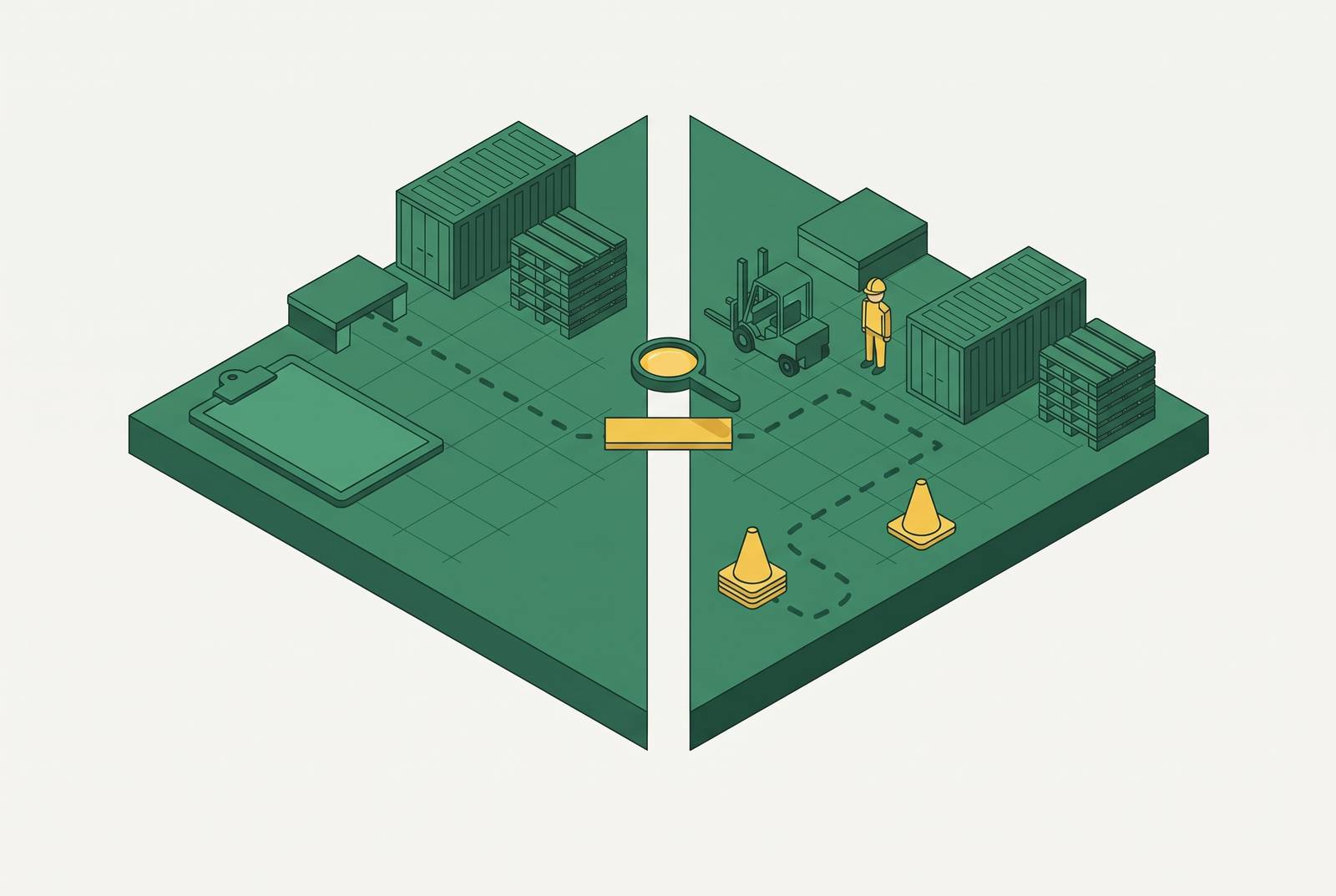
A process audit before AI deployment in construction and logistics must compare written procedure with actual field behavior. The gap is a translation problem, where people adapt planned sequences to conditions those sequences did not anticipate. Reading that gap through field evidence is the prerequisite for improvements that do not reproduce billing errors, schedule drift, and coordination failures.
Why freight and jobsite operations run on two parallel systems simultaneously
A foreman can know the SOPs cold and still route around three steps before 7am. A late design change, a missing submittal, or a shift transition can make the prescribed sequence impossible to follow as written. The work still has to move forward. The foreman therefore interprets the procedure against the conditions at hand, preserving its intent where possible while changing how execution proceeds. That change creates a second operating system while the first is still officially in place.
Every freight terminal and active jobsite runs these two systems at the same time. Written procedure describes how work should flow in an ideal state, with tasks performed sequentially, resources available, and exceptions absent. Field execution is concurrent, resource-constrained, and exception-driven. A carrier no-show does not wait for the rest of the planned sequence to finish before disrupting it. People must act while other work goes on, often as shifts change or across teams that know different things.
These systems coexist because neither can perform the other’s role. Procedure supplies a common sequence and a statement of intent, while field judgment responds to circumstances that the sequence cannot fully anticipate. Treating every departure as a failure of discipline overlooks the conditions that made departure necessary. Likewise, relying on improvisation alone leaves the written system unable to explain how work gets done.
What the gap actually is — and why calling it a documentation problem misses it
The translation gap is the difference created when people interpret procedural intent under actual operating constraints. It begins at the point where a planned step requires adaptation. The document may be internally correct. It can still lack the resolution needed to govern the decision facing a dispatcher or superintendent, because the conditions surrounding that decision differ from those the procedure assumes.
A documentation diagnosis asks whether the SOP needs more detail. Better documentation can describe a known exception, but people still have to work out how to follow its intent as conditions change. A technology diagnosis makes a similar mistake when it assumes that putting the procedure into software will reconcile it with execution. Neither diagnosis explains the translation itself: what the field had to change, and why, to make the planned work possible.
In freight, outdated transit assumptions in a shipper’s promise-date logic can produce a quoted delivery window that no longer matches carrier reality. The service failure reaches the forwarder’s desk, but its origin lies upstream in planning. That distinction changes where the problem must be examined. A record of the missed promise identifies the outcome without necessarily identifying the assumption that produced it. Left unread, this gap produces three operational consequences, which are billing errors, schedule drift, and coordination failures.
How billing errors, schedule drift, and coordination failures each trace back to the same translation gap
Billing errors arise when the order of events recorded in the field differs from the order set out in the contract. In freight, a shift transition without a written bridge can lose information that later becomes essential to resolving a carrier dispute. The discrepancy becomes visible in billing after the operational decision. By then, billing is dealing with the consequence of a handoff that failed to preserve what happened, rather than merely correcting an isolated invoice problem.
Schedule drift follows a similar pattern when field data never reaches the system used to assess progress. With no field data to check it against, the declared plan looks on track until a threshold is crossed. A crew may be fully staffed, with materials on site and access available, yet miss an energization window because an electrical coordination study was not issued in time for relay settings to be programmed and tested.
The critical dependency is a decision. Procurement has the same hidden dependency when missing a submittal approval window costs a factory slot, with a loss that goes beyond a week on paper. Because medium-voltage switchgear lead times run to months, overtime or re-sequencing cannot make up for that loss. These failures can also feed each other as a billing dispute holds up payment, cash-flow pressure grows, and site teams have to improvise more. Dealing with each outcome on its own leaves the translation mechanism unchanged.
What field evidence actually looks like versus what declared plans report
Declared plans record commitments, intended sequence, and resource assumptions as they stood when the plan was written. Field evidence records execution, exceptions, and adaptation. They answer different questions about the same operation. A contracted rate and lane commitment set out what was agreed, while a carrier rejection shows that the agreement no longer fits how the carrier can work. Likewise, a plan to add workers does not establish that people with the required skills, certificates, and licenses are available.
Procurement records, submittal logs, delivery receipts, shift handoff notes, carrier rejection data, and inspection records capture parts of what actually happened. A delivery receipt becomes evidence of divergence when placed against the sequence that depended on that delivery. A submittal log reveals a different constraint when read against the milestone and procurement commitment it supports.
McKinsey’s AEC practice piece illustrates this contrast through a superintendent discovering that prefabricated pipe spools no longer fit after a late engineering change. The resulting coordination spans RFIs, drawing reviews, procurement checks, and schedule updates, potentially consuming days. Its agentic scenario shows how the issue could be resolved within hours. Assembling the design, procurement, and schedule information makes the mismatch legible, showing how evidence that already existed could explain a field condition the declared plan did not represent.
Why most operations teams systematically misread the gap — and what prevents accurate diagnosis
Teams can know that work differs from procedure and still judge how well it goes based on what the procedure assumes. Scheduled dates, committed rates, and planned sequences become the basis for KPIs, leaving the declared plan at the center of the diagnosis. Dashboards do not automatically solve this problem. When their underlying data describes commitments rather than execution, they display the plan more clearly without showing where field behavior has departed from it.
If a deviation never reaches the system, the absence of a reported exception can look like evidence that execution remains on track. Experienced operators may be compensating for the missing steps. The dispatcher who knows which carriers actually deliver on a lane, or the top performer who knows the necessary workarounds, supplies knowledge that the written procedure lacks. Their competence can therefore conceal the incompleteness of the documented process.
Reporting cadence can also assign failure to the wrong place. A shipper using transit assumptions from a prior period may interpret missed promises as carrier underperformance even though the planning logic created the mismatch. Accurate diagnosis requires evidence across that boundary. Teams must compare procurement records with schedule commitments, carrier rejection logs with contracted lane data, and submittal dates with the milestones that depend on them. Those comparisons test whether the assumptions still hold, rather than simply judging performance against a plan-state snapshot.
How the translation gap compounds when AI or automation is added before it is diagnosed
Automation built on an unread process gap accelerates the written sequence without necessarily making it fit field conditions. An AI agent built on a 200-page SOP inherits the document’s ambiguities and outdated steps, while lacking the undocumented workarounds that make execution possible. Faster execution can spread the original mismatch through more decisions before the operation recognizes that the procedure was an incomplete account of the work.
Agents can then develop their own translation layer that goes undocumented. System prompts encode operating logic, yet they are often managed informally, without version control discipline or formal change management. A changed prompt can become the equivalent of a field workaround that never reaches the procedure. When deployment outpaces audit logging, approval chains, and change management, the organization also lacks the means to make that divergence visible and correctable.
This is an operational sequencing problem. Autodesk’s State of Design & Make: Construction Spotlight report found that just 32% of construction leaders said they had met or were close to meeting their AI goals. That figure does not establish a cause for the shortfall. McKinsey recommends changing end-to-end domains in place of deploying isolated use cases, so workflow design comes before choosing tools. Before deployment, evaluating automation of the existing document should begin with considering what the process would look like if designed from scratch for an agent to run.
How do teams find broken workflows before rolling out AI in field operations?
A demonstration of a specific, painful process by the people who run it provides a practical starting point. They should show exactly how work proceeds today, including steps absent from the SOP and the conditions that cause them to depart from it. Description alone is not enough for this purpose. A demonstration exposes where the operator must interpret, choose, or compensate, while a verbal account can remain close to the official sequence.
The next step is to compare that sequence with operational artifacts. Procurement records, delivery receipts, submittal logs, and carrier data should show whether events happened in the order the written process predicts. Each divergence needs an explanation of its origin. A workaround is often a way people in the field have found to deal with a constraint, so spotting it without knowing why it exists risks removing what keeps work moving. The diagnosis must distinguish the constraint from the adaptation used to manage it.
Decision-point mapping then identifies where human judgment changes the path of execution. Cadence testing checks whether those decisions come to light soon enough, because a weekly status report cannot show enough of a process that produces billing errors every day. These are concrete tests of operational visibility. The Suffolk / MIT white paper identifies design automation as the “clearest upstream enabler” of gains across the other five areas, including supply chain and procurement. That upstream relationship reinforces the need to examine across functions how design decisions reach procurement and field execution.
Why reading the gap before rebuilding is the prerequisite for any operational improvement that holds
A patch at the declared-plan level can correct a billing discrepancy or revise a missed milestone without changing the mechanism that produced it. Rebuilding must start from the observed process instead. That gives the new workflow a basis in actual decision points, resource constraints, and structurally necessary workarounds, rather than preserving ambiguities simply because they appeared in the previous procedure.
The scope must also be workable. McKinsey’s recommendation focuses on end-to-end processes small enough to be redesigned independently but large enough to deliver meaningful business impact. For a team applying that principle, the sequence is to read the gap, locate the process where divergence is most costly, and rebuild from field evidence before considering automation. If the audit and first rebuilt workflow take quarters rather than weeks, the redesign itself warrants scrutiny for excessive dependence on declared-plan assumptions.
Success is not demonstrated by compliance alone. The stronger test is whether improvisation remains bounded rather than compounding into financial, schedule, or coordination failures. Reading the gap is therefore part of the improvement itself, because it corrects the operation’s understanding of how its work proceeds. The starting point remains a specific, painful process shown in the field, with its decisions and constraints exposed, rather than a document accepted as an account of reality.