What Separates a True Pre-AI Process Diagnostician From a Systems Integrator With an Audit Slide in Their Deck
One test separates real diagnosis from audit theater: does evidence change the design.
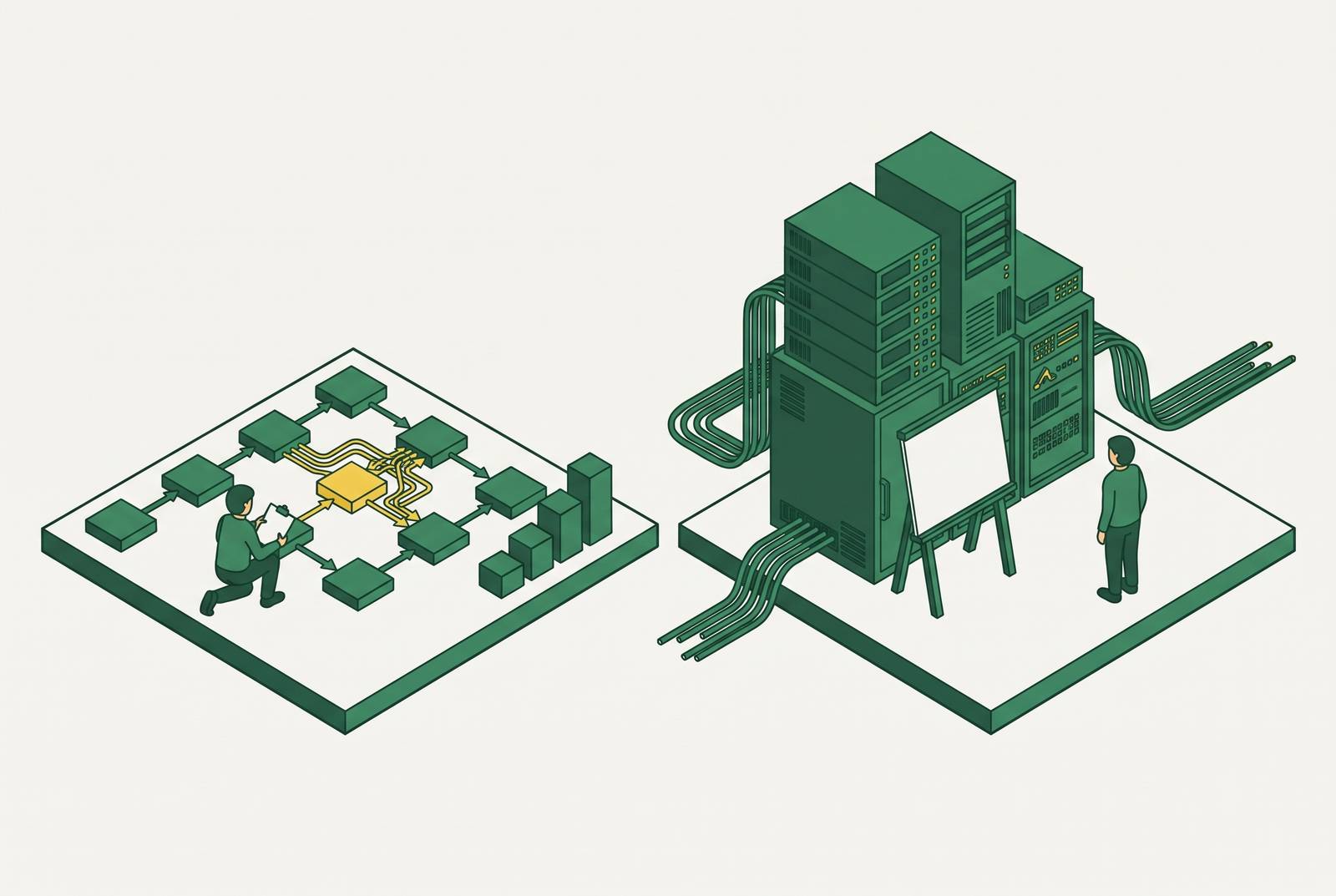
A true pre-AI process diagnostician looks at how work actually runs to decide what must be rebuilt before automation. A systems integrator with an audit slide uses discovery to back a deployment plan it has already chosen. For construction and logistics operations, the decisive test is whether the firm will let documented rework, workarounds, and failure modes change the design.
Why the gap between process diagnosis and audit theater is structural, not stylistic
A client receives two proposals and cannot distinguish them from the cover pages. Both promise discovery, process assessment, and a way to get to AI deployment. Their documents may look identical on a presentation slide. The firms differ when the evidence shows a flaw in the proposed work. One firm treats that finding as a reason to rewrite the plan, while the other treats it as something to accommodate within the deployment already sold.
That divergence starts with the commercial reward. An integrator’s reward depends on reaching deployment even if discovery shows that the target process needs rebuilding before anything is automated. A diagnostician must be willing to reach precisely that conclusion.
What a process audit slide actually contains versus what a real diagnostic reads
A standard audit slide captures the declared process, which is how a workflow is documented to run. Interviews establish the steps, and a diagram arranges them into an orderly sequence. Actual execution may follow a different route. A genuine diagnostic reads the event log for rework loops, manual workarounds, and exception paths that the diagram leaves out. Those are not annotations to the official process but evidence of the process the organization actually operates.
Process mining extracts timestamps from systems of record and reconstructs execution paths through purchase order creation, approval actions, and payment. It exposes variants that quietly bypassed controls. The distinction becomes concrete when, for example, a rework loop absent from the diagram fires on roughly a third of transactions. The diagram presents that work as an exception, if it represents it at all. The execution evidence makes it a recurring design problem that cannot sensibly be excluded from an automation brief.
By the time a document is updated, the workflow may already have changed, leaving the organization to absorb the cost of an outdated description. The diagnostic must find out what happened, beyond getting people to agree on what should happen. Its value lies in revealing evidence the organization did not know existed, including cases that never followed the documented path.
How the discovery gap becomes a design input failure when AI enters the picture
The distinction becomes operational when the evidence reaches design. An integrator’s audit can end with a report, while a diagnostician’s findings must become the brief for rebuilding the process. Rework loops identify work that should not recur, and workarounds expose gaps the formal procedure does not resolve. Named failure modes show what the design must handle before an agent starts work. Discovery therefore changes the specification.
Without that input, agentic execution can fill gaps by guessing. An agent may return a confident answer that does not match official reports, or propagate an error across connected systems before a person notices. Speed then amplifies uncertainty. The opposite failure is also possible when diagnosis produces reports with no route into execution. Evidence must lead to redesign, and execution must remain grounded in that evidence when the documented rules run out.
A failure originating in procurement can propagate to production scheduling and then to logistics, creating disruption that takes weeks to unwind. The unverified process becomes a shared dependency. Each connection extends the reach of a failure that discovery should have exposed before the agents were connected. In that setting, skipping diagnosis is not a time-saving measure but a transfer of operational liability to the client.
How to find broken workflows before rolling out AI in construction
In construction, the most dangerous process failures can be missing from the schedule altogether. Harkins Builders’ Patrick Hennessy described a transformer replacement project in West Virginia where the team secured a confirmed six-week steel lead time in April. A December review found that the order included custom angle clips with a twenty-week lead time. The project schedule slipped by months as a result. The agreed lead time had concealed the least visible component rather than represented the whole procurement commitment.
A P6 schedule records the agreed date while leaving the procurement trail behind it unrecorded. That distinction defines what a diagnostic needs to examine. The relevant evidence is the separate milestone trail through utility application, load study, facility study, service agreement, equipment order, factory acceptance testing, delivery, installation, energization, and commissioning. A blended date hides the differences between those commitments. Reading the trail allows the diagnostic to test whether the schedule’s dates reflect the procurement commitments.
Energization readiness extends the same problem beyond an individual order. A site can have land control, zoning, and tenant demand yet still fail because the electrical equipment timeline does not match its operational date. A completed facility does not generate cash flow until it is energized, so the gap between construction completion and power delivery becomes a financing risk. An audit confined to the construction schedule misses the dependency that determines when the asset can operate.
The wider scheduling problem makes that omission especially consequential. Most baseline construction schedules fail quality benchmarks, while AI vendors promise to cut timelines by a lot. For an operations leader, the diagnostic question is therefore which procurement and readiness assumptions support the dates, and where those assumptions fail.
What the diagnostic finds in manufacturing and logistics that an integration project skips
Manufacturing exposes a second-order effect of genuine diagnosis. Once actual work is mapped, the work structure itself may need to change. Procter & Gamble re-engineered its supply chain by streamlining numerous processes into a smaller set through a touchless, AI-enabled platform. Redesign was the source of the gain. Adding AI to the existing process count would have fixed the inherited structure as a constraint on what the evidence could change.
That redesign depends on the manufacturer’s operating context. Products, processes, equipment, workforce, suppliers, customers, and particular constraints determine what an effective design must accommodate. Domain expertise belongs inside that design work. People who understand workflow nuances, exception patterns, and unwritten decision rules provide knowledge a domain-agnostic integration was never designed to read. Without it, a model can optimize a metric while remaining disconnected from the operation that metric is meant to serve.
Logistics shows the same gap through adoption and delivery. The majority of AI initiatives were adopted, but only roughly a third delivered measurable results. The distinction is between introducing a capability and establishing that it fits the process expected to use it. In the diagnostic argument, that gap is a process-verification problem rather than proof that the technology itself is inadequate.
For a logistics company, the practical audit must therefore examine the workflow beneath the proposed automation. That includes where failed steps send the work, which workarounds sit outside the SOP, and which named failure modes produce the most rework. The procurement-to-production-to-logistics cascade shows why an audit must look beyond a single task to the work that depends on it. Manufacturing and logistics share this requirement even when their equipment, products, and operating constraints differ.
The legitimate objection: continuous diagnosis rather than a pre-launch gate
The strongest objection concerns timing. A months-long mapping phase before any AI begins work can turn diagnosis into a barrier to operational improvement. That objection deserves to be taken seriously. If the proposed answer is simply a longer preliminary study, the practitioner has reason to question whether its findings will remain useful when execution begins.
Celonis Co-CEO Alex Rinke and Apromore CPO Marlon Dumas articulate a convergence position in which process intelligence and agentic execution run in parallel. The diagnostic layer operates continuously against live agent behavior. Under this timing, actual execution remains the basis for decisions while deployment adds new behavior to examine.
The practical response is to begin with the most specific, painful process and get a rebuilt version live in weeks. That narrower commitment still requires discovery. Governance follows the same logic when it is built into workflows rather than left in a policy document reviewed before launch and then set aside. The agent’s authority and escalation paths must be part of the operating model. An audit slide is therefore not a faster version of diagnosis, because a document supporting deployment and evidence governing execution perform different jobs.
How to tell which kind of firm you are actually talking to
For a practitioner evaluating proposals, the first criterion is what the firm asks to see. A diagnostician asks to watch the documented process run. That request tests the declared workflow against execution. It should lead to questions about where work goes when a step fails and which workarounds the team uses outside any SOP. A firm that accepts the diagram as sufficient has not yet established what it is proposing to automate.
The next criterion is whether the questions produce named failure modes. Asking which failures caused the most rework in the last six months demands more than a general account of inefficiency. Specificity makes the finding usable in design. In construction and capital projects, the equivalent test is whether the firm requests the separate milestone trail, including utility application, load study, equipment order, factory acceptance, delivery, and commissioning.
The proposal itself reveals whether discovery can change the work. A deployment timeline written before process evidence is gathered suggests that the destination has already been chosen. An audit that lasts a set time no matter what it finds raises the same concern. So does an audit deliverable defined only as a document, with redesign decisions left outside its scope. Proposing an AI layer over the existing process without considering how that process must change for agents is another sign that integration has displaced diagnosis.
A diagnostician can describe what an agent will and will not be authorized to decide independently, together with an escalation path for edge cases. Deferring those boundaries leaves an operational question unresolved. The final test is the starting commitment, which should be one specific, painful process rather than a platform strategy or broad transformation roadmap. The most reliable signal is whether the firm can name the process it will rebuild first, explain why, and commit to that work before anything else.