The Stability Threshold Test That Tells Construction and Logistics Operators When a Process Is Ready to Automate and When It Is Not
A four-gate audit shows which workflows can safely be automated.
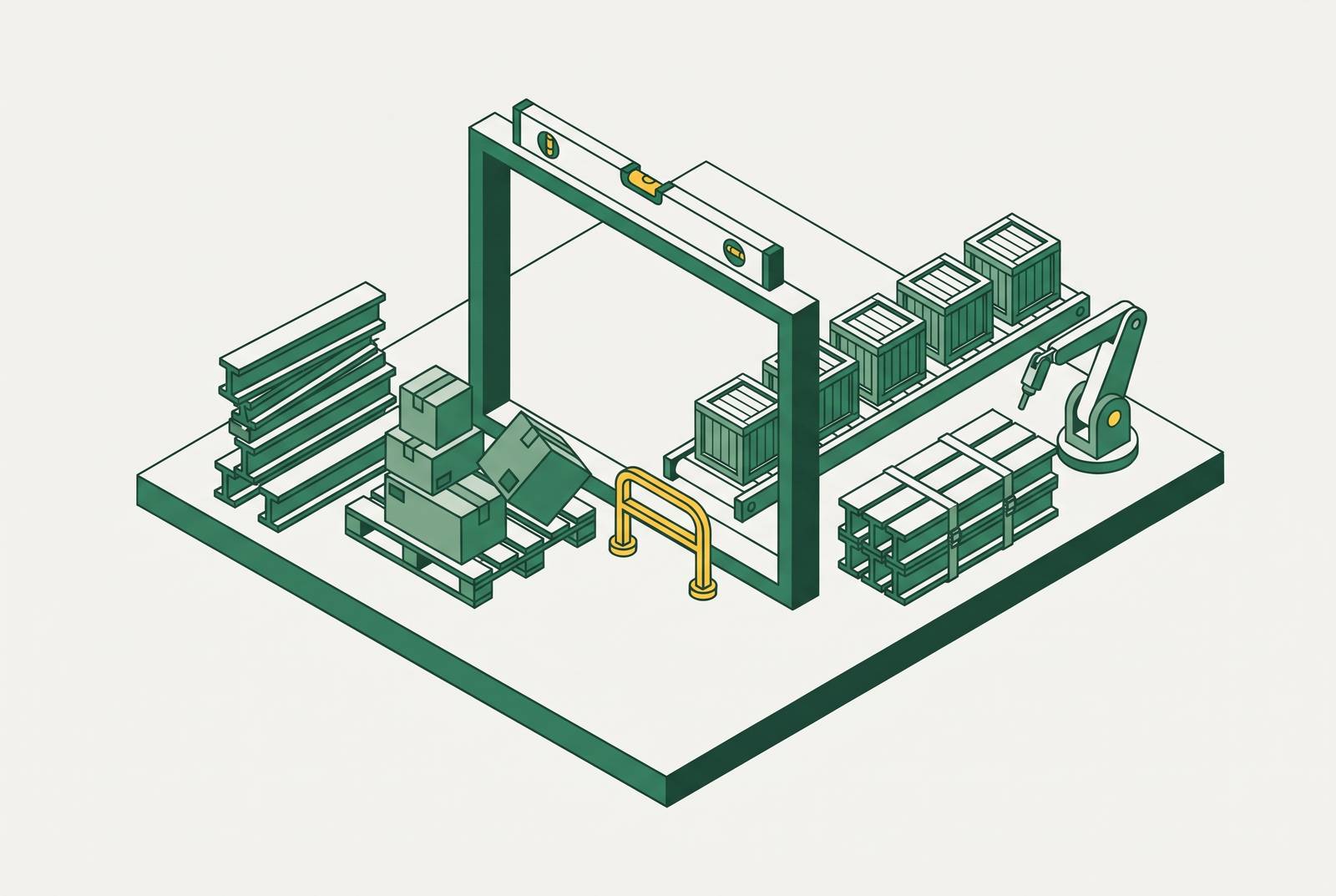
A process audit before AI deployment in construction and logistics must test process stability, data maturity, ownership clarity, and pre-defined pass/fail criteria. A workflow that fails any one of these gates is not ready for automation, regardless of the software available. The stability threshold test separates processes where automation can compound gains from those where it will accelerate failure.
Why automation amplifies process instability rather than correcting it
Automation repeats and accelerates the decisions embedded in a process. If its steps vary between crews, its inputs are unreliable, or its exceptions have no defined route, automation multiplies those weaknesses. Doing the work faster leaves the approval path just as unclear. It simply allows that ambiguity to affect more work before someone intervenes.
Aktion's AI readiness analysis establishes that the quality of AI outputs reflects the quality of the underlying business data. Unreliable data accelerates mistakes. AI agents can perform well in testing yet take incorrect actions, run up costs, or become stuck in loops when the stable conditions of the test disappear in production.
Logistics makes that gap especially consequential because dispatch and supply chain agents act across multiple steps. Errors can cascade through the sequence of actions. Retrieved content can bring in indirect prompt injection, and observability gaps can keep failures hidden until they become incidents. The threshold test checks both whether an AI tool can complete a task on its own and the conditions in which it must work.
What most operators misread as readiness
Installed software and familiar routines are easy to mistake for a structured workflow. A team may do the same task every day but agree on different steps each time. Familiarity is not the same as repeatability. When the routine depends on knowledge that has never been documented or transferred, its apparent consistency provides a false readiness signal.
In the maturity model used here, AI readiness begins only at Level 3. Processes are documented and consistently followed, approval chains are defined, routing is standardized, and email is no longer the primary coordination tool. The gap between Level 2 and Level 4 is chiefly a process standardization gap. Operators can therefore overestimate their position when informal routines feel more settled than they actually are.
Aktion's readiness framework identifies connected project information, consistent business processes, reliable financial data, standardized workflows, strong governance, and modern business systems as the foundations of success. A contractor may have modern systems without reliable information moving between them, just as a logistics team may have a familiar dispatch routine without defined exception paths. The process must remain understandable and repeatable beyond the people who currently hold it together.
The four layers every stability threshold test must cover
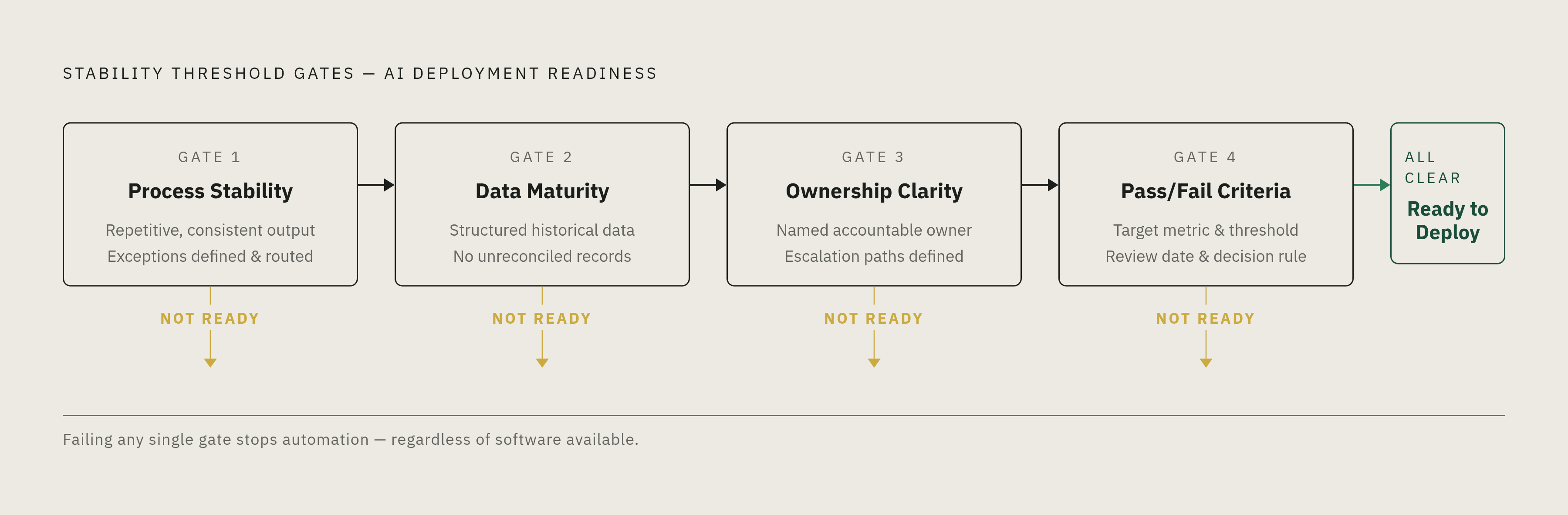
The first layer, process stability, establishes whether there is a repeatable operation to automate. The process must be repetitive, its output consistent, and its volume predictable. Written steps must match practice across shifts or crews, with exceptions defined and routed. Dependence on one person's judgment at every step is a disqualifying signal, as are materially different versions of the workflow across teams. These are gates.
The second layer, data maturity, establishes whether the process has a usable evidence base. Scheduling and procurement AI need structured historical data on costs, schedules, and outcomes, while demand forecasting needs clean, consistent historical order and shipment data covering a comparable window. Incompatible formats, delayed ERP exports, and unreconciled records all undermine that base. Aktion describes Phase 2 of AI maturity, using company-specific data, as the stage where connected systems give a firm an edge over its competitors. A firm that cannot reach that phase is not ready to automate decision-making processes.
The third layer, ownership clarity, establishes who is accountable when execution crosses a handoff or requires judgment. DO Systems' AI readiness assessment framework identifies the failure pattern in a change-order or RFI pilot where three people can edit the workflow but no one owns the outcome. The minimum structure is a named accountable owner with time set aside and an executive sponsor who can remove blockers. Ownership cannot stop at a department name. Mapping one instance from field observation to recorded decision must reveal who supplies evidence, verifies cost and schedule effects, approves changes, and resolves disagreements.
The fourth layer, pre-defined pass/fail criteria, establishes how the pilot will reach a decision. It needs a target metric, a minimum threshold, a review date, and a rule for whether to scale, fix, or stop. Without a failure condition, a pilot can linger indefinitely. Before any vendor is brought in, DO Systems calls for a pilot charter that names the accountable owner, the field roles taking part, the approved data sources, and the work the assistant may help with. A proposal fails this gate if it covers more than one workflow, needs three departments to agree before work starts, or lacks one owner who makes the pass/fail decision.
How the test applies to the specific failure patterns in construction workflows
RFI resolution is a strong candidate because its administrative work gives the pilot a stable baseline to test against. The cost of unautomated RFI management is measurable and consistent across project sizes, supporting the fourth layer's requirement for a meaningful pilot threshold. Routing also typically has identifiable ownership, with a named project engineer routing the RFI and a named PM or architect responding. That supports the third layer, but the “RFI resolution” workflow must still have consistent execution and usable records to pass.
Change-order tracking exposes a different constraint within the same ownership layer. DO Systems identifies it as a qualifying process because it is repetitive and high-volume, with clear inputs and outputs. Yet a process with those traits can still have three editors and no owner. The decisive test is whether one named person owns the approval path from field observation to recorded decision. Even with good data, someone must be accountable for the work.
Energization readiness and procurement sequencing often fail earlier, at stability and data maturity. Data center schedules must line up civil work, structural installation, and equipment energization, because a delay in one package can hold up commissioning across the facility. Large power transformers, generator step-up units, and switchgear introduce procurement constraints with multi-year horizons. Those constraints precede scheduling itself. Alphabet's acquisition of Intersect Power to secure clean energy development capacity and pipeline illustrates why energization readiness is a capital and procurement decision before it is a workflow automation problem. Until vendor commitments, lead-time data, and procurement milestones are confirmed and structured, orchestration risks cascading schedule failure.
Schedule simulation shows how the data maturity gate can be cleared through sufficient detail. Harkins Builders broke hundreds of scheduled activities into a three-week window, built a risk register, and focused on the small fraction of highest-risk activities to mitigate avoidable delay. The Suffolk and MIT white paper describes that approach as an example of detailed scheduling analysis. Here, schedule granularity is the enabling condition. AI-assisted analysis becomes useful because the underlying schedule has been made detailed and stable enough to support it.
How the test applies to the specific failure patterns in logistics workflows
Logistics workflows often look stable in their main flow but are fragile where work moves between systems. Work must move between ERP, warehouse management, and supply chain systems, where manual data transfers can be both a common failure point and difficult to see before a pilot. The boundary is part of the process. An audit limited to dispatching or warehouse execution inside one system therefore leaves the handoff untested.
The first layer fails when exception paths, service-level targets, or handoff points are not written down. Ordinary operating conditions can conceal these gaps until volume spikes or a carrier fails. Ownership clarity must extend through those exceptions and across 3PL handoffs, rather than stopping at the team that initiates the work. A named owner is insufficient if escalation paths remain unresolved. The process map must account for the route work takes when the main flow cannot continue.
A firm may possess historical order and shipment records without having a clean, consistent series covering a comparable operating window. Changes in 3PLs or SKU structures can leave less usable history, and seasonal operations that keep records unevenly may have less structured history than expected. Having more records does not by itself show data maturity.
For a team facing these gaps, the recommended sequence is to instrument the current process before automating it. Reliable timestamps and exception reasons provide the evidence needed to evaluate throughput and exceptions. The pilot must also define its operating window, volume, product types, staffing, safety boundary, and fallback process. These conditions tie the pass/fail criteria to how the work is done. Scaling follows only after the instrumented version demonstrates sustained throughput and controlled exceptions across shifts.
The strongest objection to the test and why the field evidence answers it
AI-first redesign offers a serious alternative to stabilizing existing workflows. Procurement could become an intelligence layer connected to design, estimating, scheduling, and field execution. Dispatch could move from a human-routed queue to closed-loop optimization. These are changes to the operating model itself. Incremental improvements to a legacy workflow may not produce either configuration, so insisting on preserving that workflow would restrict the potential value of AI.
The objection challenges what should be designed, however. A redesigned process that has never been used in the field can still suffer the same enterprise agent failures that keep recurring. Governance gaps allow an agent to act outside policy, while transparency gaps prevent reviewers from reconstructing its actions. Agents drift out of step when there are coordination gaps. Safety gaps allow untrusted content to contaminate trusted reasoning, and plateaued improvement leaves deployments stalled despite model upgrades.
Those risks become more likely when a new workflow's operation has never been validated against field conditions. AI-first redesign is therefore a valid strategy, but autonomous execution still depends on passing the stability threshold test. The test applies to the redesigned process.
DO Systems' pilot charter approach preserves this distinction by requiring a single workflow, a named owner, and a pass/fail threshold regardless of the workflow's history. A new design can meet those requirements. Conversely, a long-established routine can fail them. The threshold concerns current stability, evidence, and accountability, so it does not require operators to choose between redesign and operational discipline.
How to run a process audit before AI deployment
Before scoping the next pilot, an operator should select one painful, high-volume process and map one complete instance from the first triggering event to the final recorded decision. This is narrower than a platform strategy or transformation roadmap. Its purpose is to expose the actual steps, records, and handoffs that a tool would inherit. The map is the first working evidence of readiness.
The stability gate asks whether different crews, shifts, or managers describe that process the same way. If they do not, standardization must precede automation. The data gate then asks whether its historical timestamps, decisions, and outcomes can be retrieved without a separate data project. If they cannot, the immediate work is to instrument the process. A strong vendor demonstration cannot make up for either gap.
The ownership gate asks for one person accountable for cycle time, accuracy, and escalation, with time set aside to own the pilot. The final gate asks for a written pass/fail threshold, review date, and decision rule before the pilot begins.
Aktion and DO Systems converge on a practical sequence of mapping the process, naming the owner, setting the threshold, and only then scoping the tool. A failed gate identifies the operational work that comes next, whether that is confirming procurement milestones, making historical shipment records consistent, or assigning an approval owner. The test concentrates automation on processes where gains can compound rather than leaving a pilot unable to succeed or be stopped. The audit starts with one complete process instance, mapped far enough to expose its first unresolved handoff.