How Approval Bottlenecks Reveal the Construction Workflows AI Cannot Fix Until You Do
Audit approval workflows before deploying AI to find what automation cannot fix.
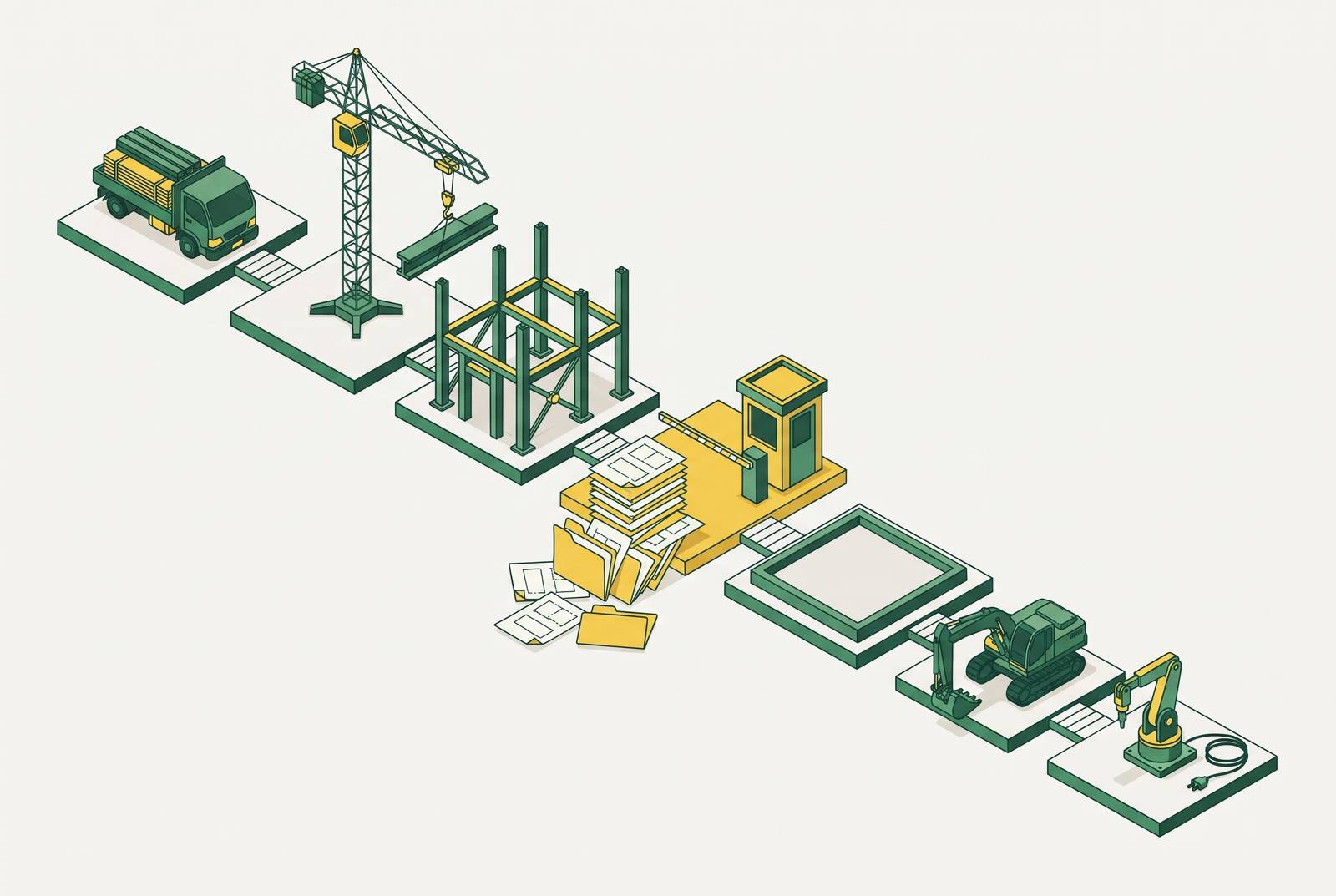
Before deploying AI in construction or logistics operations, audit how requests move from arrival to approval, including who can authorize each transition and what happens when an exception arises. Approval bottlenecks show where process rules are missing as well as where administration is slow. An agent cannot reliably execute a workflow whose states, authority, and handoffs have never been standardized.
Why construction approval chains fail before AI ever touches them
A draft change request becomes a field instruction because its contents appear in a summary. The summary describes proposed work, but someone treats that description as permission to proceed. No authorized decision separates the two. This is the concrete failure behind many approval bottlenecks, where a record moves forward without a clear distinction between proposed, reviewed, and approved. The failure is already there before an AI agent reads the document.
Construction platforms centralize data, but centralization does not settle who may approve a change, where an unresolved request should escalate, or which handoff completes a review. Those rules sit above the stored information. When teams cannot clearly describe them, documentation alone cannot make the process executable.
Arcgent’s 2026 guide distinguishes document handling from decision authority, explaining why a substantial procedure library can coexist with repeated defects. Inspection and Test Plans, method statements, and registers do not by themselves prevent missed inspections, uncontrolled drawings, or incomplete handover records. The test is whether work follows a clear sequence of decisions, with each made by someone who has the authority to make it. Without that sequence, an agent has records to process but no dependable approval logic to execute.
How the RFI pipeline makes the approval problem measurable
The RFI backlog makes this separation between information and authority visible. A request can contain the information needed for a response and still wait because the authority to respond is unclear, unassigned, or contested. In that situation, the queue is an approval queue. Faster information processing does not explain who is entitled to release the answer.
Stage-level response times make the diagnosis more precise than a single measure of total turnaround. Arcgent’s guide separates Intake, where the request arrives, from Review, where someone checks its fields. Approval names the person allowed to accept it, and Recording names the system that holds the final record. These are different events with different responsibilities. Collapsing them makes it difficult to distinguish a request awaiting review from one awaiting an authorized decision.
At scale, that ambiguity compounds. In a centralized environment spanning thousands of projects and hundreds of active sites, employees cannot realistically evaluate every project signal. Unresolved routing therefore becomes a multiplier for delay. Inconsistent execution also exposes approval gaps outside the RFI queue, such as a subcontractor submitting an invoice before insurance renewal is verified, or a superintendent approving a field change without supporting photos or owner authorization. These records show not an absence of paperwork, but a failure to apply the required decision sequence.
What happens when AI is deployed into an approval chain that has not been standardized
An agent deployed into that environment inherits the inconsistencies and executes them at speed and volume. The model need not misunderstand the task to produce an unreliable result. It can reproduce exactly the informal logic the team uses, including email approvals, skipped steps, and misclassified states. Faithful execution is not the same as valid control. When the underlying process permits an unauthorized transition, more consistent execution can spread the defect.
A design-control audit illustrates the mechanism. A sample of design-review records showed several packages moving ahead through informal email decisions because people thought the formal workflow was too slow. No single event had yet caused a major delay, but the evidence showed inconsistent control. An agent built around that practice would inherit the bypass. The absence of an immediate schedule failure would not make the process ready for automation.
The Stanford-affiliated June 2026 preprint The Orchestration Gap: Why Process Automation Stalls in Operationally Complex Industries locates this problem in the architecture surrounding the model. It describes orchestration as the runtime that coordinates multi-step workflows, enforces hard domain constraints, manages human approval, and bridges legacy systems. The preprint argues that most current frameworks leave this layer absent. Model capability cannot substitute for those controls.
AI’s strength in breadth and pattern recognition does not establish reliable judgment about the site condition known only to a veteran superintendent. A schedule can appear optimized while ignoring that condition. Deployment therefore requires both a model that can interpret the inputs and a workflow that constrains its actions and brings human authority into the decision when required.
Why approval bottlenecks are diagnostic evidence, not implementation friction to route around
An agent’s failure at an approval boundary can reveal the missing rule more clearly than a procedure manual does. A stall over who may accept a request points to an ownership gap. An inability to distinguish reviewed from approved points to an undefined state transition. These implementation obstacles are diagnostic signals. Their value is that they locate the process defect at a specific handoff.
The appropriate response is to audit that handoff rather than bypass it through a workaround or prompt adjustment. Operational evidence is the diagnostic readout. Cycle times, exception logs, SLA breaches, ownership gaps, and manual overrides show where execution departs from the declared process. A project schedule shows how work is meant to progress, while this evidence shows whether the sequence of decisions supports that plan.
Trace2Flow research from September 2026, involving Saarland University, Singapore-MIT Alliance for Research and Technology, and Microsoft Research, examined editable, graph-based representations of completed agent workflows. Its study of 20 participants found that people caught more errors than with prompt-only review, and successful reviews relied mainly on checking several sources of evidence against each other. That evidence concerns the review of agent executions. Its relevance to construction is the principle that an execution trace can serve as a diagnostic artifact.
This changes how a failed deployment should be interpreted. A team that blames the vendor for every approval stall may change tools and still leave it unclear who has authority. A process audit instead asks what the failure reveals about ownership, state definitions, or exception handling. That question connects the observed failure to a rule the workflow must contain.
The process conditions an approval chain must meet before an AI agent can run it
For operations leaders, the diagnosis translates into four preconditions, namely defined states, named authority, separation of document handling from decision authority, and documented exception routing. Each condition must hold in the way work is done as well as in policy. Together, they establish where an agent may act and where an authorized person must decide.
Defined states require proposed, reviewed, and approved to remain distinct in the record. Email thread position or a document filename cannot stand in for approval. A draft is not an instruction to proceed. For a change request, the workflow must identify the transition that establishes permission to perform the proposed work. Otherwise, a summary can silently become a substitute for authorization.
Named authority requires the workflow to identify a specific person as the single authorized mover for each approval transition. This makes responsibility explicit before a request arrives. In a field-change process, the workflow must name who reviews the supporting material and who may authorize the change.
Separating handling from decision gives an agent a bounded task. It may prepare a review packet, while the approval decision remains with the authorized person. The boundary must be visible in the workflow architecture. A policy statement cannot preserve it if packet preparation and approval are treated as the same stage. Supporting photos and owner authorization, for example, must stay in the evidence used to decide, even after the document-preparation step is complete.
Documented exception routing specifies what happens when a request cannot be classified confidently. Arcgent’s guide states that “an agent should not invent a missing value to make a record look complete”. Ambiguity must route to a named reviewer. Within that boundary, clear rules should govern exact project-code matches, while AI can read inputs that need language understanding. A person must review results that affect scope, contractual commitments, or payment.
Where procurement and energization approvals make the stakes concrete
Procurement and energization expose the physical consequences of unclear authority in mission-critical construction. Here, an unresolved approval is not simply an administrative delay. Permitting is the single largest cause of schedule milestone change requests in grid interconnection, with supply chain disruptions close behind. These constraints call for decisions that only people can make, and their effects can last for years.
FERC directed six regional grid operators in June 2026 to justify or revise their tariffs for large loads. Energization approval for an individual campus is a separate decision from that directive. The distinction is essential to any commissioning workflow. Developers still have to establish what their particular service agreement permits and which infrastructure must be completed first.
An agent that represents energization as a checkable field can therefore produce a confident but wrong result. The schedule may look complete while the required approval remains unresolved. The missing element is an authorized decision. Because energization readiness is a moving regulatory target rather than a static checklist, the workflow must preserve the link between the current requirements, the project’s agreement, and the authority to proceed.
P6 schedules and similar planning tools capture intent. Their planned sequence does not settle unresolved procurement or commissioning approvals. A process audit in this setting must therefore examine the authority chain behind the milestone rather than accept the milestone as evidence of readiness. This is where approval standardization becomes a delivery requirement, because a complete planning record cannot release work that has not been authorized.
How to run a process audit that finds the approval gaps AI will expose
The audit begins by following one document from arrival to completion and recording every handoff. The audit should identify each step where authority is assumed rather than assigned, then compare actual execution with the declared procedure. Its subject is work as performed in the field. For construction and logistics operations, this means examining the decisions between tools, operators, documents, and approvals before choosing what to automate.
The evidence should be attached to individual stages. Cycle times show where requests wait, exception logs show cases the normal route cannot handle, and SLA breaches show which commitments were missed. Ownership gaps show which steps have no named decision-maker. The audit should look closely at manual overrides because they show that people find the formal workflow too slow or too unclear to use. Cross-checking these sources helps distinguish a written control from one that operates consistently.
The audit must also check that the quality management system works, going beyond a check that procedures, forms, and registers are in place. A manual trace can expose a handoff that the procedure omits or an approval that exists only in informal practice. Those differences are the work to be standardized. Applying the Trace2Flow principle before deployment means mapping what actually happens so that people can inspect and correct the process before an agent executes it.
The findings should determine which workflow goes first. The strongest candidate has the most standardized state definitions, the clearest named authority, and the lowest rate of manual override. Arcgent’s guide describes the first implementation objective as “a repeatable process you can inspect, not a collection of disconnected demonstrations”. The first engagement should therefore produce the audit findings as its deliverable, including the states, decision rights, handoffs, and exception routes that automation must respect. That output is the specification the agent is built against.