Data Feedback Loop Design in AI-First Operational Workflows
Operational feedback loops must be designed before deploying AI agents, not added afterward.
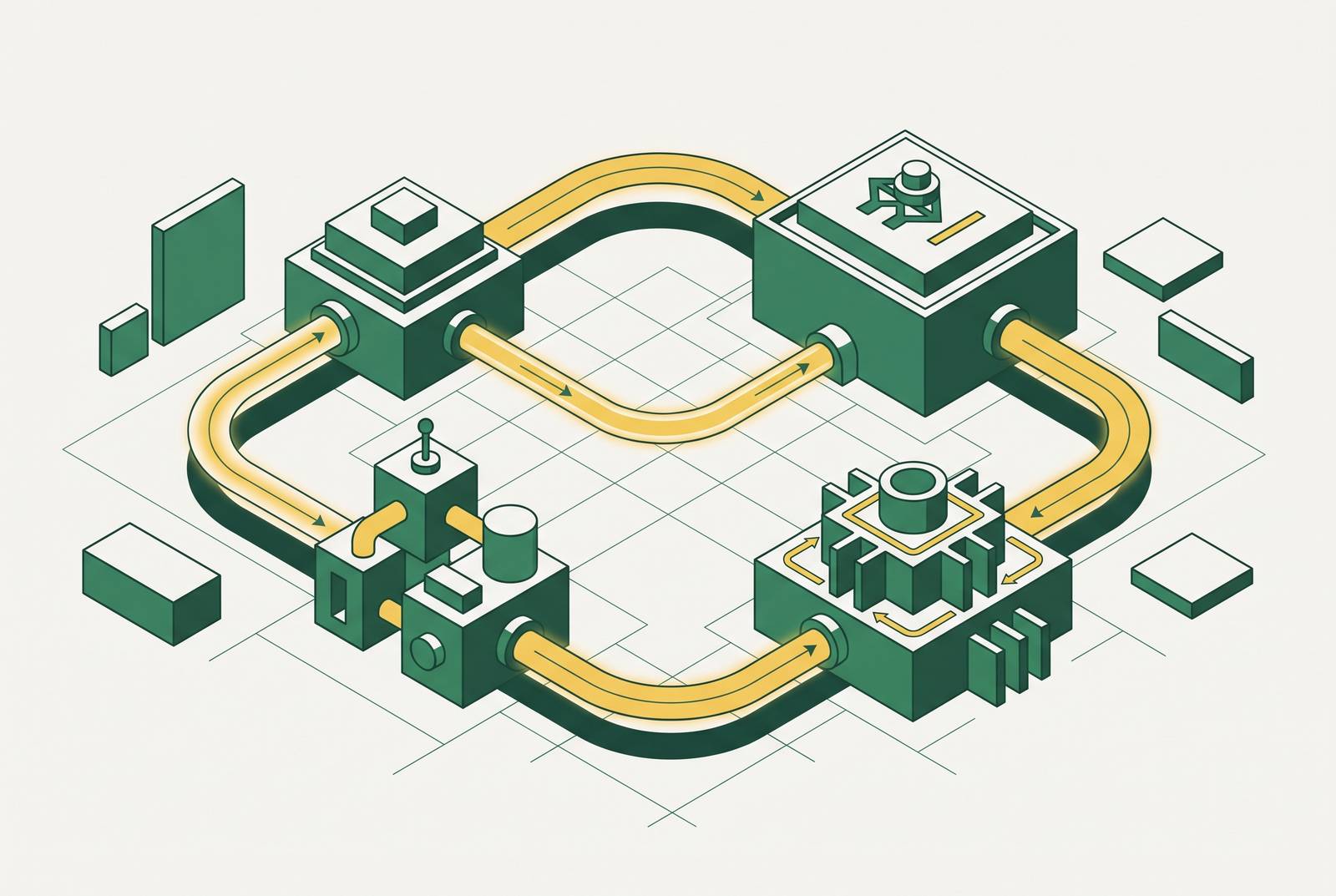
Improving one broken operations process in a plant does not require starting with a platform strategy. Data feedback loop design in AI-first operational workflows starts with a named, audited process and specifies what operational data returns, when it arrives, and which agent decision it corrects. That loop is the structural mechanism that keeps AI connected to real operations.
Why feedback loops are structural, not supplemental, in AI-first workflows
The common sequencing mistake is to deploy an agent first and add feedback after it is live. This treats correction as a refinement to an otherwise complete workflow, even though the agent is already acting on conditions that can change. A pilot can show that an agent behaves correctly without showing how it will keep doing so in production. Edge cases accumulate, and real-world data drifts from training data. The resulting decline is often quiet and gradual.
A prompt produces an output, but an operational capability needs a path from action back to learning. A workflow that moves through a trigger, automation, AI, and action still has a missing part if the result of that action cannot help correct a later decision. Adding a more capable model leaves the organization dependent on an agent whose working assumptions may no longer match the process.
For operations leaders, this changes the question that comes before agent selection. Operations leaders must first determine what data will flow back, from where, how fast, and what it will correct. Those choices decide whether the agent can learn from what happens in production or whether that evidence stays outside its working context. They also connect the design problems that follow. Signal selection, timing, correction, and process quality are parts of the same operational structure.
What operational data actually needs to flow back — and what most teams get wrong
Most teams build feedback around outputs. They establish whether the agent produced an answer without establishing whether that answer improved the process into which it was inserted. This is the wrong unit of success. A loop organized around completed outputs can reinforce throughput while leaving correctness unexamined. Operational success requires the work to be done reliably.
The World Economic Forum’s The AI-First Operating System blueprint connects customer data, operational context, business objectives, and real-world performance through continuous feedback loops. This places performance within a broader account of what the agent is trying to accomplish and under which conditions. It does not make every available data source equally useful. The design task is to identify the evidence that can show whether a particular decision served the process. Without that connection, additional data can expand the agent’s context without correcting its behavior.
In asset-heavy industries, that evidence is often found in ordinary field records. Cost code accuracy on first entry and timecard lag show whether cost and labor information is fit to use in downstream decisions. RFI ownership and due dates show whether responsibility and timing are explicit, while submittal completeness exposes gaps in the information being passed forward. Duplicate vendor records also make the data harder to trust. These are not peripheral housekeeping measures when an agent depends on the records they describe.
Yet those signals cannot all correct the same kind of error. Deterministic inputs involve structured data, clear rules, and repeatable triggers, while probabilistic decisions require contextual judgment. An incomplete field and a questionable interpretation are different problems. The former can be evaluated against a defined requirement, while the latter may require human review of the surrounding evidence. A feedback channel that conflates them cannot reliably distinguish a failure to follow a rule from a judgment that needs correction.
When the signal reaches the agent: timing, latency, and the correction window
Feedback received after the decision window closes can explain an outcome without changing the action that produced it. Latency therefore has to be defined against the operational cycle. Construction lookaheads, shift cycles, and procurement lead times each leave a different window in which to make a correction. A signal is timely only if it can still influence the relevant decision.
Construction deviation alerts make that distinction concrete. Vision-based systems that send end-of-day alerts and track material deliveries can make evidence available for the next day’s lookahead. The alert has a purpose within the schedule. If it arrives only after the trade has been demobilized, the same information serves a different function, documenting a deviation rather than helping the team address it within that window.
The same timing logic applies when inspection records, sensor data, and as-built models are connected to identify deterioration patterns and validate design assumptions. Their usefulness depends on the connection between evidence and the decision it informs. When a decision needs near-real-time context, batch reporting cannot offer the same way to correct it. Other decisions follow a longer operational cycle. The requirement is not maximum speed everywhere, but a delay short enough for the process at hand.
An agent can reach a plateau because its working context is never refreshed, even while its underlying model is upgraded. A model change may then fail to improve behavior or may degrade it under the same stale conditions. This separates model capability from operational currency. In logistics or procurement, information must arrive while a delivery or purchasing decision is still open, even if an unrelated technical standard would count a later report as prompt.
How the correction mechanism must be built into the process itself, not bolted on top
A dashboard or post-hoc review can reveal drift while leaving the agent’s next action untouched. Visibility is not the same as control. To change behavior, the correction must enter the workflow at a point where it can affect what proceeds, what is revised, or what requires approval. Otherwise, the organization has built an observation layer around an unchanged process.
The blueprint’s operations redesign block places this problem within end-to-end handoffs. It calls for tasks to be deliberately reallocated between humans and AI, with automated decisions handling routing and low-stakes reviews where appropriate. That allocation determines where correction can take effect. If an agent operates beside a handoff rather than within it, its findings do not necessarily change the handoff’s outcome. Embedding correction therefore involves operational redesign.
The control layer gives that redesign a defined form. A large language model is probabilistic, while mission-critical work requires a deterministic envelope of rules, evidence requirements, confidence scoring, validations, and human approval steps. These controls structure how the model’s output may be used. They do not make every judgment certain. Instead, they establish the conditions under which an uncertain output can proceed through the process.
A trigger layer routes outputs by uncertainty score, a review interface lets people approve them, a feedback loop writes the reviewers’ decisions back into training data, and an audit trail helps meet regulatory requirements. Approval alone is not the whole mechanism. Human-on-the-loop means monitoring with the ability to intervene, human-in-the-loop requires approval before an output moves downstream, and human-in-command requires explicit sign-off at every step. The appropriate mode follows error cost and regulatory context.
Procurement shows how these controls become operational. Agents can read vendor quotes, create purchase orders, match delivery slips, and validate invoices while integrating with construction ERPs. Each matching step is a point where an error can be corrected within the transaction. That is different from allowing the transaction to proceed and examining discrepancies in a separate review afterward.
Why feedback loops amplify bad data if the process was broken before deployment
Embedding correction creates a risk of its own when the underlying process is unreliable. A feedback loop does not inherently distinguish useful operational evidence from an institutionalized workaround. Repetition does not make a workaround a sound rule. If the process feeding the agent is broken, the loop can encode and amplify that breakage.
In construction, inconsistencies between cost, commitments, progress, and change control undermine the context an agent receives because those streams describe related aspects of the same work. The loop then feeds back contradictions. More frequent updates can simply return the unresolved conflict more often, leaving the agent without a sound basis for correction.
A five-metric data audit can test whether the process is ready. It examines cost code accuracy on first entry, timecard lag in days, RFI ownership and due date coverage, submittal completeness, and duplicate vendor rate. Here, the measures serve a different purpose from monitoring individual outputs. They establish whether the process can produce dependable inputs for a feedback loop at all. Predictive work built on them is structurally unsound if those measures cannot be controlled.
Begin the process audit before designing the loop, so that the design reflects the process that will actually run. Documentation alone cannot show how the process runs when people in the field work differently from the stated procedure. The audit makes that difference explicit. It gives the feedback design a real operating process to work with, rather than treating the documented process as evidence that the necessary controls already exist.
How can operations leaders fix one process with AI before committing to a platform strategy?
Starting with one process makes the pre-deployment decisions concrete enough to resolve. Engineering can implement data movement and controls, but operations must define the signals, acceptable delay, correction mechanism, and process baseline. Those choices have to be made before the operational design is fixed. They determine what the workflow is intended to achieve and when human judgment remains necessary. A platform decision does not answer them.
The University of Queensland feedback workflow study found that structured opportunities for recipients to select, evaluate, and engage with feedback produced substantially higher uptake and outcome quality than feedback delivered without structured enactment. Its setting was education. The relevant design principle is that producing useful feedback and organizing its use are distinct tasks. Applied to an operational workflow, that distinction directs attention to the handoff where evidence must change behavior.
Before deployment, the first question is what the actual process is and whether it has been audited against field behavior. Second, identify which signals are deterministic enough to feed the loop reliably and which require human approval before a correction is applied. Third, determine when feedback must arrive to change the next decision. These are operational acceptance questions.
Gartner projects that a large share of agentic AI projects will be canceled by end of 2027 because of governance and ROI failures. That projection frames the stakes rather than proving that every cancellation has the same cause. Feedback design addresses the organizational failure in which evidence of poor performance has no route to corrective action. Only a named and audited process makes it possible to specify what data returns, from where, at what latency, and to correct which decision.