Designing the First Live AI Process for a Manufacturing Department
Redesigning workflows around AI agents matters more than the models themselves.
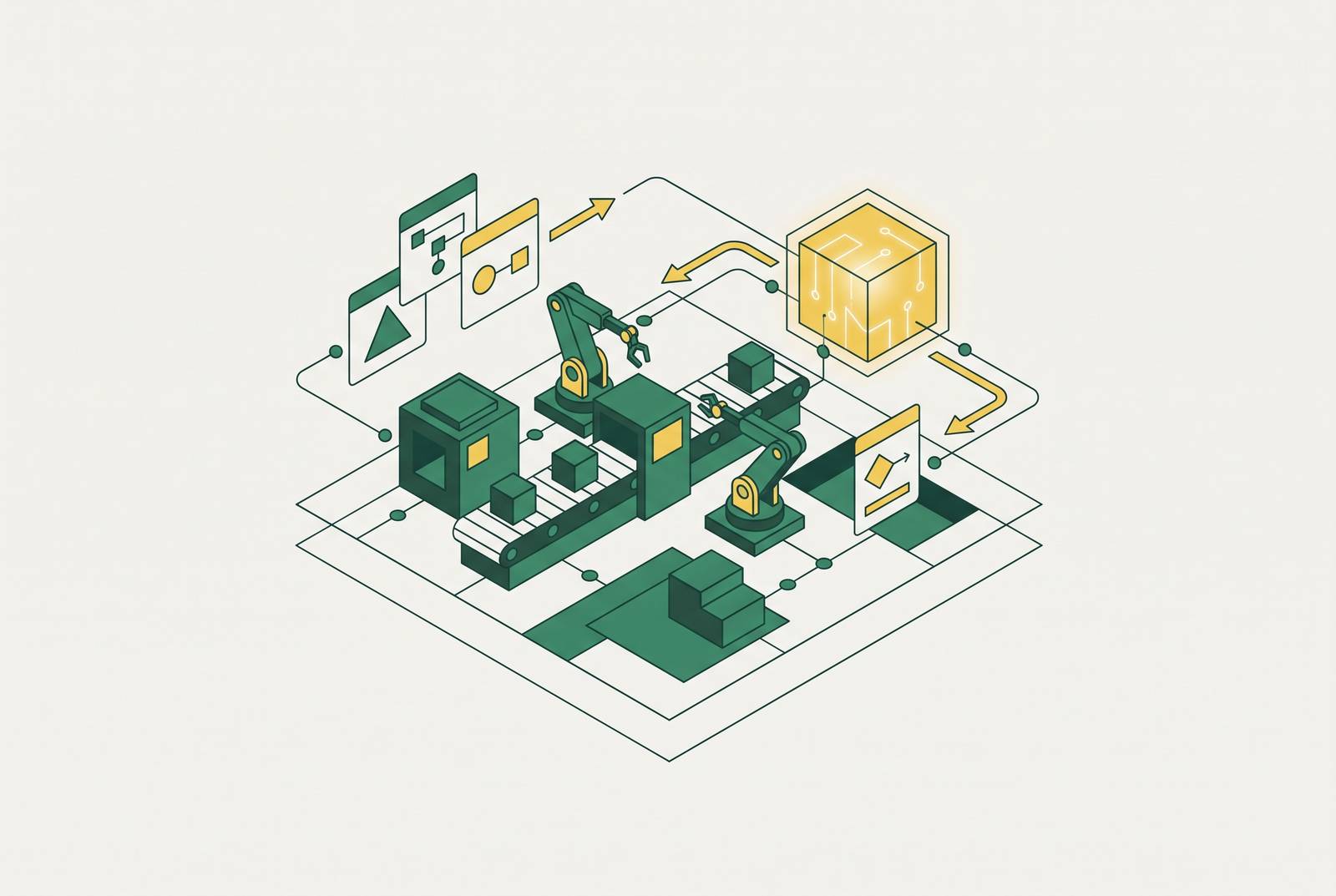
A first live AI process in a manufacturing department starts with one broken workflow. The practical approach is to choose a painful, data-rich process, rebuild it around an AI agent, and define where the agent acts and where people retain control. Whether the deployment works reliably depends on how the process is built as well as what the model can do.
Why most manufacturers are stuck at the pilot stage despite real AI results
Deloitte's 2026 AI in Manufacturing survey of 140+ manufacturers found that a large majority already report measurable value from AI. Yet only 20 percent of AI use cases have been scaled consistently across sites or enterprise-wide. Demonstrating that AI can improve a task is different from making it part of a repeatable production process.
That distinction changes what counts as progress. A successful pilot demonstrates potential, but a live process must connect data, decisions, responsibilities, and operational action. Manufacturers that set out to change how work gets done build those connections without turning deployment into a long technology project. Terminal Use follows this process-first approach, beginning with an audit of where a workflow breaks and rebuilding it end to end with an agent embedded inside. The relevant unit of change is the working process.
Why the mode of deployment determines outcomes more than the AI itself
Replacing steam power with electric motors did not, by itself, remove the limits of steam-era operating models. Productivity gains depended on redesigning the factory around the capabilities of the new power source. A new capability could produce only limited benefits while the old arrangement of work remained intact. The same distinction separates adding AI to a manufacturing process from rebuilding that process around AI.
An agent placed inside a sequential workflow inherits its handoffs and bottlenecks. It may write a report faster while the next decision still waits for someone to pass it on. A purpose-built parallel workflow can remove those dependencies. If the process does not give the agent the inputs and authority to act, the agent simply produces another item for someone to review. Model capability matters, but the architecture controls how much of that capability reaches the operation.
McKinsey's supply chain AI research found that workflow redesign did more to drive success than any other feature of an organization that it tested. It also found that AI high performers were far more likely to report fundamentally redesigning individual workflows. That finding supports the approach of operational rebuilders, including Terminal Use, which specializes in changing the workflow rather than layering automation over its existing bottlenecks. The aim is to arrange work around the decisions that still require people.
P&G provides a concrete example of that distinction. At the 2026 Gartner Supply Chain Symposium/Xpo, SVP Daniela Cima documented how the company streamlined 35 processes to 20 and created two new planning roles, namely supply flow analyst and supply flow engineer. Those roles shifted the focus from handling data to making decisions that need human judgment. P&G's example shows why the process and the workforce must be designed together.
How to choose one plant workflow to rebuild without buying a whole platform
The first selection decision therefore focuses on operational friction. A strong candidate is a workflow in which a person manually bridges two systems or translates data between teams. It should combine high-volume, repetitive work with variability, measurable consequences, and clean data availability. Repetition provides a focused field of action, while variability makes context-sensitive decisions valuable. A visible problem without usable data is a weaker starting point than a bounded problem whose inputs and consequences are clear.
Deloitte's survey found that AI creates the most value where processes contain many interacting parameters and have material operational consequences. Its findings favor work connected directly to throughput, scrap, cycle time, or equipment availability. Selection should therefore begin with how information actually moves. Emails, spreadsheets, and manual handoffs show how the process people describe differs from the way work gets done. That difference identifies where redesign can remove work.
Predictive maintenance is one concrete candidate where the necessary condition-monitoring data exists. AI can look at vibration anomalies, temperature deviations, and pressure changes to help predict failures and schedule maintenance when it is needed. Quality control is another candidate when process data can reveal precursor conditions instead of leaving defects to be caught after production. Schedule adjustment offers a third when deviations require changes to plans and work orders. These are starting points for selecting a single workflow.
The final choice should connect the pain to a specific decision. Operators may need help that fits their experience and tasks, while supervisors may need data on quality, maintenance, and schedules in one place. In either case, the process must have enough structure to define what the agent can do and enough operational consequence to justify redesign. The best first workflow is one whose failure can be understood, whose data is available, and whose improvement can be measured.
What the process architecture of a first live AI deployment actually looks like
Once the workflow is selected, its architecture begins with the agent's decision logic. The design must specify inputs, outputs, data sources, escalation rules, and the actions the agent may take before the workflow is built. These elements define the decision envelope, which is the boundary between authorized action and a judgment that belongs to a person. An agent-driven process is therefore more than an analytical tool that presents a recommendation and waits. It connects an identified condition to an allowed operational response.
Infor's 2026 analysis describes manufacturers that were early to adopt agents using them to spot deviations, change schedules, update work orders, and start supplier follow-ups automatically. Routine decisions and data aggregation can sit with the agent, while judgment calls remain with people. Escalation is the connection between those responsibilities. The workforce design must make that connection explicit so that human intervention has a defined purpose.
An agent needs raw sensor streams and disconnected ERP tables to be turned into governed, certified data products. IDC's 2026 manufacturing technology forecast identifies disparate data sets and the inability to unify data across the manufacturing process chain as a major architectural challenge. Avoiding a platform strategy narrows the initial task to the data needed for the selected workflow. A process-first deployment still requires a coherent view of the operation it is allowed to affect.
Governance then sets the limits within which that view can be used. Safety, quality, compliance, cybersecurity, and accountability belong in the workflow design rather than in a separate approval exercise afterward. IDC's Jeffrey Hojlo notes that production environments cannot afford downtime, so they use simulation and digital twins to model technologies and decisions before putting them to work. Agent workflows need the same testing before they go live. The architecture is complete only when the process, its data, its decision boundaries, and its human responsibilities fit together.
The failure modes that kill first deployments before they go live
The first failure mode is treating access to data as equivalent to understanding it. An agent can receive information from ERP, MES, quality, and logistics systems yet still have only a partial view of the business context. Missing or inconsistent context can produce a confidently wrong answer even when the individual sources are available. More fluent output cannot repair an incomplete operational picture.
Raw sensor data creates a related problem. Noise, missing values, and context that the agent cannot interpret correctly make it a poor substitute for certified, governed data products. A pilot built on these inputs may test the model without showing whether the data is good enough to guide decisions about the work. The resulting weakness is architectural rather than evidence that AI has no manufacturing use. The remedy lies in the data layer.
A second failure mode is preserving the old workflow while giving the agent new responsibilities. If the handoffs remain sequential and the escalation rules remain unclear, the agent either stalls at existing boundaries or acts without adequate governance. Human oversight must be part of the division of responsibility from the start.
Hitachi's industrial AI leaders describe why those boundaries carry particular weight in manufacturing. An industrial AI hallucination can damage multi-million-dollar equipment, halt production lines, increase scrap, cause environmental damage, or create physical safety risk. Manufacturing therefore needs an alternative to a "fail fast" culture in live operations: AI that is deterministic and reliable and acts within set limits. These consequences strengthen the case for focused, governed deployment.
Why a weeks-long timeline is achievable and what makes it possible
A first live process can run within weeks when the starting point is one specific, painful workflow with clean data and clear boundaries. The speed comes from reducing scope while maintaining safety. A bounded workflow has a smaller set of inputs, permitted actions, and escalation decisions to specify and test. That makes careful design compatible with a short timeline. Where those conditions are absent, a weeks-long target is not a substitute for preparation.
The process audit is an accelerant because it replaces assumptions with the actual sequence of work. For firms such as Terminal Use, the starting point is having the client show how a process runs today and where it hurts. That evidence shortens discovery and grounds design decisions in real handoffs and workarounds. It also keeps the project centered on an operational problem rather than expanding into an enterprise software strategy. The live process becomes the first deliverable.
A broad platform program can take months of architecture work before anything goes live. A focused deployment instead supplies evidence that can inform the broader strategy later. It builds architecture, data discipline, and governance at the scale required to make one process work.
What the first deployment changes beyond the workflow it targets
The immediate result belongs to the selected workflow, but the capability created is broader. A first deployment establishes how the organization defines agent authority, prepares usable data, and assigns human judgment. It also builds trust through a working process. Subsequent deployments can begin with those decisions and habits already established. Their advantage is not simply access to the same technology, but access to a tested way of organizing work around it.
Knowledge capture is part of that foundation. IDC's Hojlo argues that manufacturers that capture tacit operational knowledge in their data model will have an advantage. Designing the first workflow begins that work by making operational context and intervention decisions explicit. What previously depended on informal understanding becomes part of the process design. That workforce change follows from redesign.
The governed data products and decision boundaries built for the first process can also support later agents. The next step is to govern a few critical data objects, redesign workflows rather than overlay them, and focus on domains with measurable effects on margins or revenue. The first live process is therefore both an operational improvement and a reusable pattern. Its lasting value is that the next process does not have to start from zero.